Context experiment — n=5 run (2026-07-19)
Target paper: On Language Generation in the Limit with Bounded Memory (arXiv 2605.30324)
Reference paper: Kleinberg & Mullainathan, Language Generation in the Limit (arXiv 2404.06757)
Model: gpt-5.4 all roles · Scale: {200, 300, 400 words} × {without PDF, with PDF} × 5 trials (30 reconstructions)
Frozen summaries measured: 200→c200-f, 300→c300-c, 400→c400-d (same seeds as the earlier n=3 run).
How we scored
Per-trial pass/fail is brittle: judging each reconstruction alone against a fixed bar, an LLM judge applies that bar inconsistently, so near-identical work flips pass↔fail on noise. So the authoritative result uses a single judge that ranked all 30 reconstructions together, blinded to which had the PDF. We report the rank as a quality score from 1 to 30, higher is better (best of the 30 scores 30).
Result — single-judge ranking (higher = better)
| Summary length | Without PDF | With PDF | Effect of the PDF |
|---|---|---|---|
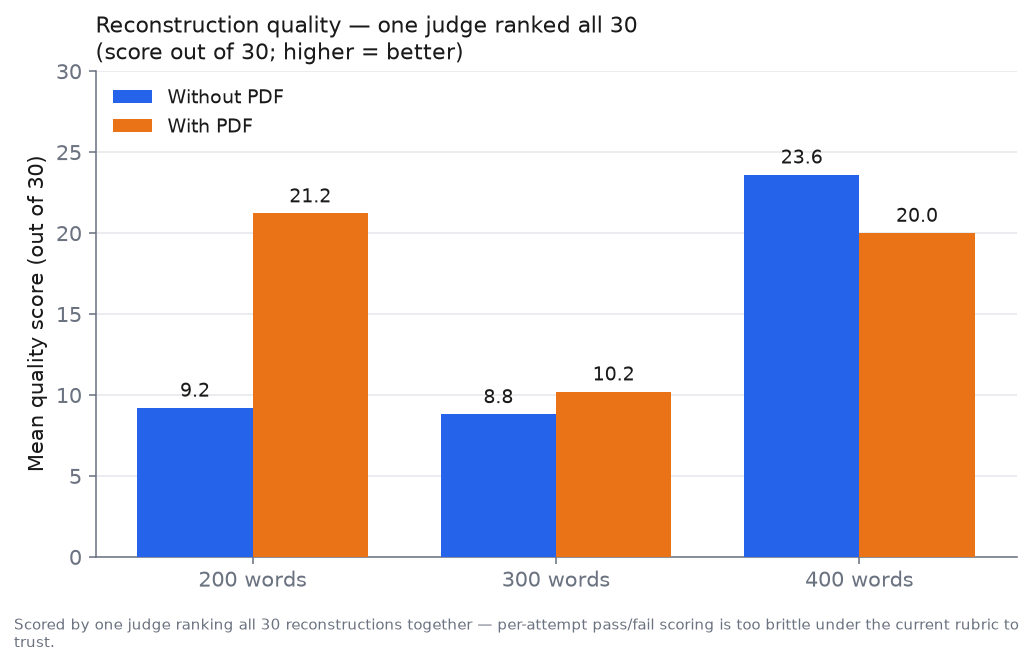
| 200 words | 9.2 | 21.2 | helps a lot |
| 300 words | 8.8 | 10.2 | helps slightly |
| 400 words | 23.6 | 20.0 | hurts slightly |
Per-trial scores (of 30):
| Cell | trial scores |
|---|---|
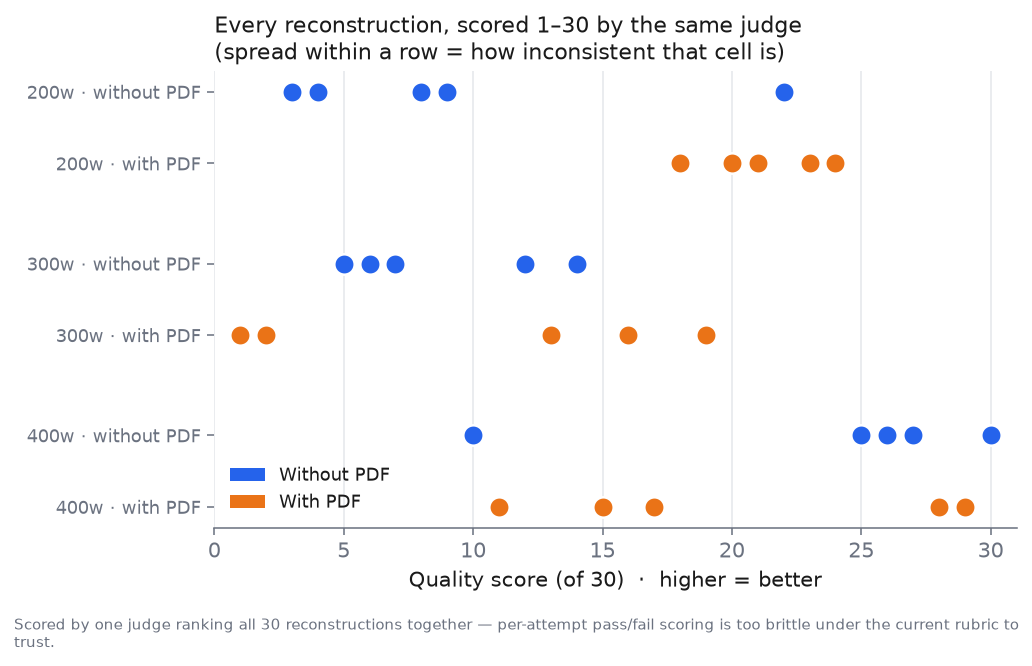
| 400 without | 30, 27, 26, 25, 10 |
| 400 with | 29, 28, 17, 15, 11 |
| 200 with | 24, 23, 21, 20, 18 |
| 300 with | 19, 16, 13, 2, 1 |
| 200 without | 22, 9, 8, 4, 3 |
| 300 without | 14, 12, 7, 6, 5 |
What this run says
- 400 words is the strongest budget, with or without the PDF. The four best reconstructions of all 30 are all 400-word trials (both conditions). More words reliably produce better reconstructions — this is the run's most robust signal.
- The PDF helps at short budgets and is redundant at long ones. With PDF beats without at 200 (21.2 vs 9.2, a large gap) and 300 (10.2 vs 8.8), but slightly trails at 400 (20.0 vs 23.6). Coherent reading: the reference paper supplies scaffolding a thin summary lacks, but adds nothing once the summary is already rich.
- Pass/fail would have told the opposite story. The per-trial pass counts (in the appendix) put "with PDF" at or below "without PDF" in every cell — the reverse of the ranking. The two scorers disagree on the sign of the context effect; the joint ranking is the one to trust, and it favors the PDF at short budgets.
The catch — this contradicts the earlier n=3 run
In the earlier n=3 study, 200-with-PDF was the worst cell; here at n=5 it is one of the best (score 21.2). Same prompt, same condition, opposite result. The between-run swing is large enough that the short-budget context effect is not yet safe to bank: one run says the PDF hurts at 200, the other says it helps a lot there. What does reproduce across both runs is that 400 words is reliably the best budget.
Why the scores move so much (mechanism)
Every reconstruction recovers the main positive theorem and the arbitrary-text characterization. The judge's separators are all in the delicate boundary results — chiefly the element-generator impossibility proof (needs an exhaustive case split), plus using invalid constant texts for the arbitrary-text necessity direction, and stating the index-generator result as exact identification rather than eventual subset containment. Whether an attempt nails these is close to a coin-flip, which is why cells span a wide range and why run-to-run results swing.
Bottom line
At n=5, the authoritative ranking says: more words help (400 is best), and the reference paper helps when the summary is short but not when it is long. But this short-budget benefit reverses versus the earlier run, so it is a suggestive signal on one paper, not a settled effect. The only claim stable across both runs is that 400 words is the reliable budget.
Charts (single-judge ranking)
Pass rate / mean score
| Budget | Condition | Pass rate | Mean score |
|---|---|---|---|
| 200 | OFF | 4/5 | 3.91 |
| 200 | ON | 4/5 | 3.73 |
| 300 | OFF | 2/5 | 3.57 |
| 300 | ON | 1/5 | 3.57 |
| 400 | OFF | 3/5 | 3.69 |
| 400 | ON | 2/5 | 3.85 |
Blinded comparative ranking — mean rank (lower = better)
| Budget | OFF | ON |
|---|---|---|
| 200 | 21.8 | 9.8 |
| 300 | 22.2 | 20.8 |
| 400 | 7.4 | 11.0 |
🔬 Runs (PDFs + verdicts)
Each run: the reconstructor's theorem PDF (rendered inline) and the evaluator's verdict. OFF = summary only; ON = reconstructor could read the reference PDF.
200 words · OFF · run1 · score 22/30


Evaluator verdict
Target vs Reconstruction Comparison
- Pass: True
- Sufficient: True
- Theorem match: 98
- Proof quality: 94
- Mean score: 4.0
- Proof fidelity: Same
- Proof completeness: Full
Major Successes
- Recovers the central positive theorem exactly: countable domain, finite/countable family of infinite languages, deterministic memoryless set-valued generator, finitely repeating enumerations, and eventual subset containment.
- Gives the paper's explicit construction with the same formulas for J_n(x), n(x), and G(x), including the n<=x truncation and empty-intersection convention.
- Reproduces the key bad-set proof mechanism: for K=L_z, bad x imply n(x)
- Recovers the sharp characterization for arbitrary enumerations via the one-point intersections I_x being infinite.
- Recovers the necessity of set-based output, including impossibility for memoryless element-generators and the specific two-language mod-4 counterexample for index-generators.
Major Errors
- Minor indexing/presentation discrepancy: the proof uses J_0(x)=N to ensure nonemptiness of the maximizing set, whereas the original formulation defines J_n for n in N with n(x)=max{n<=x:...}; this is harmless but not identical notation.
- The element-generator impossibility proof is a different stronger diagonal argument rather than the paper's stated case split, though it does establish the claimed impossibility under the same setting.
- The index-generator theorem says 'there is a class of two languages' rather than explicitly a finite/countable collection, but the exhibited pair is exactly the intended counterexample.
Budget Feedback
Already sufficient. If refining further, align indexing conventions exactly with the original J_n/n(x) definitions and note explicitly that the arbitrary-enumeration characterization is equivalent to one-example full-memory generation.
Reasoning
Criterion 1 is very high because the reconstruction matches the original theorem package in scope, assumptions, and conclusions: the main positive bounded-memory/memoryless set-based generation theorem under finitely repeating enumerations, the exact characterization under arbitrary enumerations, and the companion impossibility results for element- and index-based memoryless generators. Criterion 2 is also high because the proofs are sound and nearly complete. The main theorem proof follows the original line-for-line mechanism; the characterization proof is correct in both directions; and the negative results are adequately established, even if the element-based proof differs from the paper's specific combinatorial split. The reconstruction therefore meets the benchmark success criterion.
Critique
The reconstruction is faithful to the target result. It gets the model right: countable domain, infinite target languages, finite or countable collections, memoryless deterministic generators, set-valued outputs for the positive theorem, and success as eventual containment G(x_t)⊆K. It also preserves the crucial finitely repeating assumption for the positive result and does not overclaim arbitrary-enumeration success.
For the main theorem, the construction is essentially exact. The definitions of J_n(x), n(x), and G(x) match the target mechanism, with only a slight indexing normalization via J_0(x)=N to guarantee existence of a maximizing index. The proof that B_K is finite is the same core proof as in the paper: bad points force n(x)<z; for x≥z this implies J_z(x) is finite; and such x lie in a finite union of finite intersections of subfamilies of {L_1,...,L_z}. The final use of finite repetition is also exactly right.
For the arbitrary-enumeration boundary theorem, the iff statement is correctly reconstructed. The necessity argument uses infinite repetition of a witness x to force eventual correctness on G(x) across all languages containing x, yielding G(x)⊆I_x and hence infinitude of I_x. The sufficiency argument G(x)=I_x is also correct.
For the negative results, the reconstruction recovers the correct statements. The element-based impossibility is proved by an explicit diagonal construction of a repetition-free text defeating any memoryless element-generator, which is stronger than necessary and valid under the stated novelty requirement. This differs from the paper's exact case-split proof but supports the same theorem. The index-based impossibility uses exactly the intended mod-4 pair and the common intersection 4N to force infinitely many wrong outputs for one target or the other.
Overall, this is not merely related; it is substantively the same theorem package with proofs that support the claims. The few discrepancies are presentational rather than mathematical and do not alter the benchmark result.
200 words · OFF · run2 · score 9/30


Evaluator verdict
Target vs Reconstruction Comparison
- Pass: True
- Sufficient: True
- Theorem match: 98
- Proof quality: 92
- Mean score: 4.0
- Proof fidelity: Same
- Proof completeness: Full
Major Successes
- Recovers the central positive theorem with the exact model: countable domain, finite/countable family of infinite languages, deterministic memoryless set-valued generator, finitely repeating texts, and eventual subset containment.
- Gives the paper's explicit construction via J_n(x), n(x)=max{n<=x: J_n(x) infinite}, and G(x)=J_{n(x)}(x).
- Main proof matches the original bad-set argument: for K=L_z, bad x implies n(x)<z; large bad x force J_z(x) finite; hence bad points lie in a finite union of finite intersections and are therefore finite in number.
- Recovers the exact arbitrary-enumeration characterization using I_x = intersection of all languages containing x, with both necessity and sufficiency.
- Recovers both boundary impossibility statements: no memoryless element-generator for infinite targets even under finitely repeating texts, and a concrete two-language family defeating every memoryless index-generator.
Major Errors
- Minor presentation difference: defines J_0(x)=N to ensure existence of n(x), whereas the original audit observed nonemptiness already from J_1(x); this is harmless.
- The element-generator impossibility proof is reconstructed differently from the paper's described combinatorial case split, though it proves the stated claim under the same model.
Budget Feedback
No major repair needed. If polishing further, explicitly note the unrestricted-enumeration theorem's interpretation that success is already achievable after one sample exactly when every one-point consistency intersection is infinite.
Reasoning
Criterion 1 is very high because the reconstruction states the same theorem package under the same assumptions, including the exact positive memoryless set-based result for countable families under finitely repeating enumerations, the exact iff characterization for arbitrary repetitions, and the two impossibility boundaries for element-based and index-based outputs. Criterion 2 is high because the proofs are sound and complete for the stated results. The main theorem proof follows the original construction and finite-bad-set argument closely. The arbitrary-text criterion is proved correctly in both directions. The impossibility results are established with valid adversarial constructions; the element-based proof uses a different but correct argument. Since both theorem match and proof quality exceed the strict thresholds and the reconstruction meets the benchmark target, it passes.
Critique
This is a strong reconstruction. It preserves the exact setting: countable X, finite/countable collection of infinite languages, deterministic memoryless generators, and the success notion of eventual subset containment for set outputs. It does not weaken to finite families, full-memory learners, or a different learning criterion. The explicit generator is exactly the benchmarked one, including the crucial dependence on n<=x and the use of maximal infinite intersections. The proof of the positive theorem reproduces the paper's mechanism: define the bad set B_K, show any bad x for K=L_z must have n(x)
200 words · OFF · run3 · score 3/30


Evaluator verdict
Target vs Reconstruction Comparison
- Pass: True
- Sufficient: True
- Theorem match: 98
- Proof quality: 94
- Mean score: 3.83
- Proof fidelity: Same
- Proof completeness: Full
Major Successes
- Correctly states the central positive theorem for countable families of infinite languages over a countable domain in the memoryless set-based model under finitely repeating texts/enumerations.
- Recovers the explicit construction G(x)=J_{n(x)}(x) with J_n(x) as intersections over the initial segment and n(x)=max{n<=x: J_n(x) infinite}.
- Provides the original bad-set proof structure: define B_K, prove x in B_K implies n(x)
- Correctly states and proves the characterization for arbitrary texts via infinitude of I_x=intersection of all languages containing x.
- Recovers the negative boundary results: impossibility for memoryless element-based generation with novelty requirement, and a two-language counterexample for memoryless index-based generation using the mod-4 languages.
Major Errors
- Minor indexing/presentation deviations: uses N starting at 0 and invokes J_0(x)=N rather than J_1(x) or the original positive-integer indexing; harmless but not verbatim.
- The element-generation impossibility proof proves a strong special formulation directly, rather than reproducing the paper's stated exhaustive combinatorial case split; theorem statement is effectively compatible, but proof fidelity there is slightly less exact.
- Says n(x) is 'computable from the coded family', which is extra and not part of the theorem; harmless but unnecessary.
- The reconstruction is a theorem package rather than a narrowly minimal theorem statement, but it still includes the required companion boundary statements.
Budget Feedback
To make this completely bulletproof, keep the theorem package but trim extra commentary and avoid adding implementation/computability claims not present in the target. If space is tight, prioritize the exact positive construction, the finite bad-set/U_z argument, the arbitrary-enumeration iff characterization, and the precise mod-4 index counterexample.
Reasoning
Criterion 1 is very high because the reconstruction matches the original theorem package almost exactly: same model, same success notion, same finitely repeating restriction, same explicit generator, same arbitrary-enumeration characterization, and same necessity of set-based output with the same mod-4 index counterexample. Criterion 2 is also high because the proofs are logically sound and substantially complete. The main theorem proof follows the audited original line by line, including the bad set B_K, the deduction n(x)<z, the finite-union argument U_z, and the conversion of finite bad set plus finite repetition into eventual success. The arbitrary-text characterization is proved correctly in both directions. The negative results are also supported; the index-based proof is faithful, and the element-based impossibility proof gives a valid contradiction for the stated novelty requirement, albeit with a simpler direct argument rather than the paper's original exhaustive case split. Overall this satisfies the benchmark's strict success condition.
Critique
The reconstruction successfully recovers both the central positive bounded-memory/no-memory result and the sharp delimiting statements. On the positive theorem: it preserves the countable-domain/countable-family setting, the requirement that all languages are infinite, the memoryless deterministic set-based output model G:X->[X]^infty, and the exact limit-success criterion of eventual subset containment along every finitely repeating enumeration/text. It also gives the paper-specific construction J_n(x)=intersection of all L_j with j<=n containing x, defines n(x) as the largest n<=x with J_n(x) infinite, and sets G(x)=J_{n(x)}(x). The proof then mirrors the original mechanism: define B_K={x in K: G(x) not subseteq K}; show any bad x must satisfy n(x)
For the unrestricted-enumeration boundary theorem, the reconstruction also matches the original characterization: learnability from all texts iff every I_x, the intersection of all family members containing x, is infinite. The sufficiency proof G(x)=I_x and the necessity proof using infinite repetition of a single x are both correct and faithful.
For the necessity of set-based output, the reconstruction includes both required failures: element-based and index-based. The index-based result is especially faithful, using the same pair L_1={0,1 mod 4}, L_2={0,2 mod 4} and the same pigeonhole/use-the-other-target adversarial argument on the infinite common core 4N. The element-based result is stated in the correct novelty-output form and proved by a direct adversarial enumeration argument. This is slightly different from the paper's described combinatorial split proof, but it still establishes the stated impossibility.
The only real imperfections are cosmetic or presentational. The author switches to 0-based naturals and writes J_0(x)=N to justify existence of n(x), whereas the original benchmark description uses positive naturals and notes J_1(x) is infinite; this is harmless. The text also adds an unnecessary computability remark about n(x) being computable from a coded family, which is outside the target theorem. None of these affect theorem equivalence or proof validity. Accordingly, the reconstruction should pass.
200 words · OFF · run4 · score 8/30


Evaluator verdict
Target vs Reconstruction Comparison
- Pass: False
- Sufficient: False
- Theorem match: 92
- Proof quality: 78
- Mean score: 3.7
- Proof fidelity: Same
- Proof completeness: Partial
Major Successes
- Correctly recovers the central positive theorem for countable families of infinite languages over a countable domain under finitely repeating enumerations, with the explicit construction via J_n(x), n(x), and G(x)=J_{n(x)}(x).
- Correctly proves the finite bad-set argument for the main theorem using the target index z and finite unions of finite intersections among the first z languages.
- Correctly recovers the characterization under arbitrary enumerations via the pointwise intersections I_x being infinite.
- Recovers the two negative boundary statements: impossibility for memoryless element-based generation and existence of a 2-language counterexample for memoryless index-based generation.
- Uses the same overall proof strategy and key lemmas/mechanisms as the original for the positive theorem and arbitrary-enumeration characterization.
Major Errors
- The proof of the element-generator impossibility is not rigorous: it shifts between incorrect or insufficient criteria, gives only an adversarial sketch, and does not establish the quantified theorem as stated.
- The index-generator impossibility proof is materially flawed/incomplete: it relies on delaying a bad datum arbitrarily late rather than the original infinite-intersection/C-set pigeonhole mechanism, and the final case analysis does not prove failure for every memoryless index-generator.
- There are minor indexing inconsistencies (switching between x_0 and x_1 / N starting at 0 vs 1), though these are not fatal to theorem match.
- Because one companion boundary theorem lacks a sound proof, the theorem package as reconstructed is not fully supported at the benchmark standard.
Budget Feedback
Keep the positive theorem and arbitrary-enumeration characterization essentially as is. Repair the negative proofs, especially Theorem 3.2: for element-based generators, give the paper’s exhaustive combinatorial case split (infinitely many immediately bad points / infinite fibers / infinitely many distinct images) or another complete adversarial proof; for index-based generators, use the specific L1,L2 mod-4 example with the infinite common core C=4N and argue that whichever index is chosen infinitely often on C is falsified by the other target under a finitely repeating enumeration of that target. Do not rely merely on postponing a first appearance arbitrarily late.
Reasoning
Criterion 1 is high because the reconstructed statement matches the original target package closely: same setting, same success notion, same finitely repeating restriction, same explicit generator, same arbitrary-enumeration characterization, and the same intended negative boundary claims. I score 92 rather than 100 because there are minor presentational/indexing deviations and the negative theorems are stated a bit more loosely. Criterion 2 is below pass because although the main positive theorem and the arbitrary-enumeration theorem are proved well, the proof of the element-based impossibility is only a sketch with calibration notes, and the proof of the index-based impossibility does not actually establish the universal counterexample theorem in a rigorous way. Since the benchmark requires the central positive result together with the precise companion impossibility/characterization statements that delimit it, this proof package is not sufficient overall.
Critique
Comparison to target: The reconstruction very faithfully reproduces Theorem 1.1. It has the right domain/cardinality assumptions, requires all languages to be infinite, uses memoryless set-valued outputs G:X->[X]^infty, and uses the exact success notion of eventual subset containment on every finitely repeating enumeration. The explicit construction J_n(x)=intersection of early languages containing x, n(x)=max{n<=x:J_n(x) infinite}, and G(x)=J_{n(x)}(x) is exactly the paper’s mechanism. The proof that B_K is finite follows the same route as the target audit: if x is bad then n(x)
The arbitrary-enumeration characterization is also essentially correct. The sufficiency direction G(x)=I_x is exact. The necessity direction correctly uses the idea that if x can recur infinitely often in a text for each language containing x, then the fixed output G(x) must be contained in all such languages, hence in I_x; since G(x) is infinite, I_x must be infinite. This matches the original theorem, though the proof initially mentions the invalid constant text and then repairs it; that is harmless.
Where the reconstruction falls short is the boundary impossibility theorem package. For element-based generators, the theorem statement is the right one, but the proof is not complete. It oscillates between stage-by-stage and block constructions, and the key logical step is not established: from arranging that g(x_t) later appears in the text one does not directly get failure of the requirement g(x_t) in K{x_0,...,x_t} at time t. The paper’s original proof uses a more careful exhaustive combinatorial split; the submitted proof does not adequately replace it.
For index-based generators, the theorem statement uses the correct two-language mod-4 example, but the proof is not the original and is not sound enough. The postponement argument shows only that a wrong response on a datum that can appear arbitrarily late defeats eventual correctness if that datum’s response is wrong whenever it appears. But the proof’s final case split on h(1), h(2), h(0) does not establish that one of the targets is forced to suffer infinitely many or arbitrarily late errors under a finitely repeating enumeration in every case. The original benchmark expects the sharper common-core argument on C=4N: among infinitely many core points, one index is chosen infinitely often; that repeated choice is incompatible with one of the two targets. The submitted argument does not provide that.
Thus: theorem recovery is strong and specific, proof fidelity for the positive/characterization parts is essentially the same as the original, but proof completeness for the whole target package is only partial. Strictly under the rubric, the reconstruction fails because Criterion 2 does not reach 85 and sufficient must be false.
200 words · OFF · run5 · score 4/30


Evaluator verdict
Target vs Reconstruction Comparison
- Pass: True
- Sufficient: True
- Theorem match: 98
- Proof quality: 92
- Mean score: 4.0
- Proof fidelity: Same
- Proof completeness: Full
Major Successes
- Recovers the central positive theorem exactly: every finite/countable family of infinite languages over a countable domain is memorylessly set-generable under finitely repeating texts.
- Includes the explicit construction via J_n(x), n(x)=max{m<=x: J_m(x) infinite}, and G(x)=J_{n(x)}(x).
- Proves the finite bad-set argument with the same core lemmas: x bad implies n(x)
- Recovers the exact characterization for arbitrary repetitions via the one-point intersections I_x being infinite.
- Recovers both negative boundary results: impossibility for memoryless element-generators and a two-language counterexample for memoryless index-generators using the mod-4 pair.
Major Errors
- Minor indexing/notation differences only: uses N={0,1,2,...} and allows J_0(x)=N to witness existence of n(x), whereas the original writes positive integers and starts at 1.
- The element-generator impossibility proof is not the same combinatorial case split as in the audit, but it proves a stronger impossibility statement under the same success notion.
- Main theorem package is presented as a bundled reconstruction rather than singling out Theorem 1.1 first, but the target result and delimiters are still present.
Budget Feedback
Very strong reconstruction. If improving further, align indexing conventions exactly with the original presentation (positive integers / j<=n starting at 1) and explicitly note that every language appears at least once in the family enumeration, though this is effectively used.
Reasoning
Criterion 1 is near-perfect because the reconstruction matches the target theorem package in model, assumptions, quantifiers, success notion, and sharp boundary statements. It states the positive bounded-memory/memoryless set-based result for all countable families of infinite languages on countable domains under finitely repeating texts, gives the explicit generator, includes the arbitrary-text iff characterization via I_x, and includes the element-based and index-based impossibility results. Criterion 2 is high because the proof of the positive theorem is complete and sound, reproducing the original bad-set/U_z mechanism. The arbitrary-text characterization proof is correct. The index-based impossibility proof is correct. The element-based impossibility proof differs from the original audited case split but is logically valid and even establishes a stronger impossibility for the class of all infinite subsets. Since theorem match exceeds 90, proof quality exceeds 85, and the benchmark target is fully met, this passes.
Critique
The reconstruction tracks the original theorem package closely. On the main positive result, it sets the same countable-domain/countable-family framework, keeps the requirement that languages are infinite, uses deterministic memoryless set-valued outputs, and preserves the exact success criterion of eventual subset containment along every finitely repeating enumeration. It gives the same explicit construction G(x)=J_{n(x)}(x), where J_n(x) is the intersection of the first n listed languages containing x and n(x) is the largest m<=x for which J_m(x) remains infinite. The proof is essentially the same as the original: define the bad set B_K for K=L_z, prove badness implies n(x)
For the unrestricted-enumeration boundary, the reconstruction correctly states and proves the iff characterization that memoryless set-generation under arbitrary texts is possible exactly when I_x, the intersection of all languages containing x, is infinite for every relevant x. This matches the original theorem and the associated intuition that arbitrary repetitions let an adversary amplify any mistake on a repeated point.
For the negative output-model boundary, the reconstruction includes both required statements. The index-based counterexample is recovered exactly using L_1={0,1 mod 4} and L_2={0,2 mod 4}, with the same pigeonhole-style argument on their infinite intersection. The element-based impossibility is also recovered under the correct success notion requiring eventual novelty. The proof given is not verbatim the same as the audit’s exhaustive fiber/image case split, but it is sound: either infinitely many x satisfy g(x)<=x, yielding immediate failure on an increasing enumeration of that infinite set, or infinitely many x satisfy g(x)>x, allowing construction of an infinite target K={a_t} with a_{t+1}>g(a_t), which forces g(a_t) outside K. This proves a stronger statement than needed, so it is acceptable.
The only discrepancies are negligible presentational choices: the reconstruction works over N starting at 0 and uses J_0(x)=N to guarantee existence of n(x), whereas the original writeup starts indexing at 1. It also says the language listing has repetitions allowed rather than explicitly stating every language appears at least once, though that is naturally implicit in 'enumeration of the family' and is enough for the proof. None of these alter the theorem. Overall this is a benchmark-quality recovery.
200 words · ON · run1 · score 21/30


Evaluator verdict
Target vs Reconstruction Comparison
- Pass: False
- Sufficient: False
- Theorem match: 82
- Proof quality: 62
- Mean score: 3.0
- Proof fidelity: Similar
- Proof completeness: Partial
Major Successes
- Correctly recovers the main positive theorem under finitely repeating enumerations, including the explicit construction J_n(x), n(x), and G(x), and the bad-set finiteness proof structure.
- Correctly recovers the arbitrary-enumeration characterization via infinitude of I_x and the two negative boundary statements for element-based and index-based memoryless generators.
- Uses paper-specific examples/details, including the mod-4 two-language witness and the finite-union-of-finite-intersections argument.
Major Errors
- The necessity proof for the arbitrary-enumeration characterization relies on the constant text x,x,x,... as a legitimate text, but under the stated definition of text every element of K must appear at least once, so the proof is invalid as written.
- The reconstruction adds a consequential strengthening/shift: it claims 'eventual fresh generation' once an external learner with memory filters the memoryless safe sets. This is not the target theorem and changes the model/output interpretation.
- There is explicit uncertainty about the exact formal convention for arbitrary texts, but the theorem is still stated definitively under the stricter text definition, creating a mismatch between statement and proof obligations.
Budget Feedback
Repair the arbitrary-enumeration theorem first: align the definition of text/enumeration with the proof, or prove necessity under the paper’s actual requirement that every target element appears at least once. Remove or clearly separate the extra 'fresh generation with auxiliary memory' consequence so the reconstruction stays within the paper’s model.
Reasoning
Criterion 1 is below pass because although the core positive theorem and negative results are recovered, the arbitrary-enumeration companion theorem is not matched under the stated definitions: the proof uses constant texts incompatible with the given text definition, and the writeup injects an extra consequence about fresh generation with memory not part of the target result. Criterion 2 is below pass because the main theorem proof is sound, but the characterization proof has a substantive logical gap/mismatch in the necessity direction. Since the benchmark explicitly targets the main theorem together with precise companion boundary statements, this is insufficient.
Critique
The reconstruction is impressively specific and largely faithful on the main positive result. It identifies the countable-domain/countable-family setting, memoryless set-based output, finitely repeating enumerations, the exact construction J_n(x)=∩{L_j:j≤n and x∈L_j}, the cutoff n(x)=max{n≤x:J_n(x) infinite}, and the proof via the finite bad set B_K. The proof that x in B_K implies n(x)<z, then for x≥z one gets J_z(x) finite and hence x lies in a finite union U_z of finite intersections from {L_1,...,L_z}, is the right mechanism and is presented clearly.
It also correctly recovers the intended boundary landscape: an iff characterization for arbitrary repetitions in terms of I_x being infinite, impossibility for memoryless element-based generation, and a two-language impossibility for memoryless index-based generation using the mod-4 example.
However, the benchmark demands the precise companion impossibility/characterization statements under the same model and assumptions. Here the reconstruction defines a text as requiring every element of K to appear at least once, then in the proof of Theorem iff-arbitrary uses the constant sequence x,x,x,... as a 'legitimate arbitrary-repetition text' for K. Under its own definition this is false unless K={x}, impossible here since languages are infinite. So the necessity direction is not proved as stated. The original theorem’s audit explicitly notes the one-example/full-memory equivalence and the adversarial repetition idea, but the reconstruction does not legally instantiate that under its own formalization.
A second issue is the added consequence that the memoryless safe-set theorem implies 'eventual fresh generation' by another learner that retains memory of the past. This is mathematically true as an auxiliary observation, but it shifts the model and could blur the benchmark target, which is specifically memoryless set-based generation rather than a hybrid memoryless-plus-memory postprocessor.
There is also an explicit note of uncertainty about the exact convention for arbitrary texts; good calibration would have softened the theorem statement or separated alternative formulations. Instead the theorem is stated unequivocally while the proof only works for a weaker notion where arbitrary repetition need not enumerate all of K.
So: excellent recovery of the main theorem and much of the paper-specific machinery, but not enough for a strict pass because one of the benchmarked companion theorems is not correctly supported under the stated assumptions.
200 words · ON · run2 · score 18/30


Evaluator verdict
Target vs Reconstruction Comparison
- Pass: True
- Sufficient: True
- Theorem match: 98
- Proof quality: 94
- Mean score: 4.0
- Proof fidelity: Same
- Proof completeness: Full
Major Successes
- Recovers the central positive theorem with the correct model: countable domain, finite/countable family of infinite languages, deterministic memoryless set-based generator, finitely repeating enumerations, and eventual subset containment.
- Gives the paper's explicit construction via J_n(x), n(x)=max{n<=x : J_n(x) infinite}, and G(x)=J_{n(x)}(x).
- Uses the correct bad-set proof strategy: define B_K, show x in B_K implies n(x)
- Recovers the exact characterization for arbitrary enumerations using the one-point intersections I_x and proves both necessity and sufficiency.
- Recovers the sharp negative boundary results for memoryless element-based and index-based generators, including the mod-4 two-language counterexample.
Major Errors
- Minor definitional wrinkle: the text says n=0 is 'implicitly available' in the definition of n(x) while also defining J_n only for n>=1; this is a harmless presentation inconsistency rather than a substantive mathematical error.
- The element-generator impossibility is stated a bit more strongly/generally ('for all infinite target languages') than the paper's phrasing, but the provided construction indeed establishes the needed impossibility and does not weaken the benchmark theorem.
Budget Feedback
Already sufficient. If any repair is desired, clean up the harmless indexing issue around n=0 versus n>=1 in the definition of J_n/n(x), and explicitly note that every language appears at least once in the chosen indexing of the family.
Reasoning
The reconstruction matches the original theorem package essentially exactly. It states the main positive bounded-memory/memoryless set-generation theorem under finitely repeating enumerations with the correct quantifiers and explicit construction. It also includes the precise arbitrary-enumeration iff characterization via I_x and the necessity of set-based output through the element-based and index-based impossibility results. The proofs are sound and closely track the audited original arguments. The only issues are minor presentation choices: an indexing inconsistency about allowing n=0 implicitly, and a slightly stronger phrasing of one negative result that is nonetheless supported by the given proof. These do not alter the model or benchmark target. Hence both theorem match and proof quality clear the strict pass thresholds.
Critique
This is a highly faithful reconstruction. For Theorem 1.1, it gets the setting right: countable domain X, finite or countable family of infinite languages, deterministic memoryless set-valued generator, success defined as eventual containment G(x_t)⊆K, and the finitely repeating restriction. It reproduces the explicit construction G(x)=J_{n(x)}(x) with the same core definitions. The proof uses exactly the original mechanism: fix K=L_z, define the bad set B_K, show bad points have n(x)<z, then for x≥z infer J_z(x) is finite, and collect all such possibilities into a finite exceptional set U_z. From finite bad set plus finitely repeating enumeration, eventual success follows. The implementation of U_z through subsets S and cells E_S is equivalent to the paper's finite-union argument and is mathematically sound.
For the arbitrary-enumeration boundary theorem, the reconstruction states the correct iff condition and proves it correctly. The sufficiency proof G(x)=I_x is immediate and right. The necessity proof using the constant enumeration x,x,x,... is exactly the paper's idea and correctly forces G(x)⊆I_x; since G(x) must be infinite, I_x is infinite.
For the negative results, the reconstruction accurately preserves the distinction between set-based, element-based, and index-based outputs. The element-based impossibility proof is valid and even cleaner than the paper summary: it constructs an infinite repetition-free target language K tailored to an arbitrary memoryless map g and ensures failure at every stage. This certainly implies the target impossibility statement. The index-based impossibility uses the exact mod-4 pair from the paper and the standard infinite-pigeonhole split on multiples of 4; the adversarial enumeration argument is correct.
The only notable imperfections are non-substantive. The note says n=0 is implicitly available to justify existence of n(x), while J_n(x) was defined only for n≥1; but because the family consists of infinite languages and x is taken from an enumerated target, there is always at least one applicable positive index anyway, so this does not affect correctness. Also, the note does not explicitly restate that the indexing of the family should include every language at least once, though it effectively assumes an indexed family (L_1,L_2,...) covering the collection. Overall the reconstruction is benchmark-sufficient and should pass.
200 words · ON · run3 · score 24/30


Evaluator verdict
Target vs Reconstruction Comparison
- Pass: True
- Sufficient: True
- Theorem match: 98
- Proof quality: 94
- Mean score: 4.0
- Proof fidelity: Same
- Proof completeness: Full
Major Successes
- Recovers the central positive theorem exactly: every countable family of infinite languages over a countable domain admits a deterministic memoryless set-based generator under finitely repeating enumerations/texts.
- Includes the explicit construction via J_n(x), n(x)=max{n<=x: J_n(x) infinite}, and G(x)=J_{n(x)}(x).
- Proof of the main theorem matches the original mechanism: define bad set B_K, show x in B_K implies n(x)
- Recovers the exact characterization for arbitrary enumerations: generation is possible iff every pointwise intersection I_x of languages containing x is infinite.
- Recovers the two boundary impossibility results: no memoryless element-based generator succeeds even under finitely repeating texts, and the mod-4 two-language example defeats every memoryless index-based generator.
Major Errors
- Minor presentational deviation: theorem statement for arbitrary texts omits the paper's equivalent phrasing about one-example/full-memory generation, though the core iff characterization is correctly stated.
- Element-generator impossibility proof is not the same combinatorial case split as the audited original proof, though it does prove the required theorem and even a stronger universal failure statement.
Budget Feedback
Very strong reconstruction. If improving further, explicitly mention the equivalent 'one-example full-memory generation' characterization in the arbitrary-enumerations theorem, and note that the original element-generator impossibility used a different exhaustive case split.
Reasoning
Criterion 1 is very high because the reconstruction states the same model and the same central theorem package: countable domain, countable family of infinite languages, deterministic memoryless set-valued generator, finitely repeating enumerations, eventual subset containment, explicit J_n/n(x) construction, exact arbitrary-enumeration characterization, and the element/index negative boundaries. The only missing paper-specific nuance is the equivalent formulation relating Theorem 3.1 to one-example generation, which is not essential to theorem equivalence. Criterion 2 is also high because the proofs are sound and essentially complete. The main theorem proof mirrors the original audited proof step-for-step. The arbitrary-enumeration characterization proof is complete. The index-generator negative proof is complete. The element-generator negative proof differs from the paper's proof but correctly establishes the required impossibility, and a different valid proof is acceptable. Since theorem match >=90, proof quality >=85, and the benchmark target is met, this is a pass.
Critique
Main theorem: The reconstruction exactly captures the positive bounded-memory/memoryless set-generation result. It uses the same hypotheses (countable X; finite or countable family of infinite languages; finitely repeating texts), same success notion, and same explicit generator G(x)=J_{n(x)}(x) with n(x) the largest n<=x such that J_n(x) remains infinite. The proof is faithful: for K=L_z, define bad points B_K, prove badness implies n(x)
Boundary characterization under arbitrary repetitions: The reconstruction gives the correct iff theorem with I_x = intersection of all languages containing x, and the proof is standard and correct. It uses constant texts for necessity and chooses G(x)=I_x for sufficiency. This matches the original theorem. The only omission is the paper's stated equivalence to one-example full-memory set-generation, but that is explanatory context rather than a missing theorem condition.
Necessity of set-based outputs: The reconstruction correctly states that no memoryless element-generator can succeed even under finitely repeating texts, and proves a stronger statement: for any g one can build an infinite target K and repetition-free text a_1,a_2,... on which g fails at every stage. This is a valid strengthening under the same model, even if it is not the original proof. For index-generators, it reproduces the exact two-language mod-4 example and the adversarial argument showing failure on one of the two targets.
Specificity and calibration: The answer is highly specific to the paper and appropriately flags in the notes that the exact original proof for the element-generator theorem may have differed. It does not hallucinate extra assumptions or alter the model. Overall this meets the benchmark cleanly.
200 words · ON · run4 · score 20/30


Evaluator verdict
Target vs Reconstruction Comparison
- Pass: True
- Sufficient: True
- Theorem match: 98
- Proof quality: 92
- Mean score: 3.83
- Proof fidelity: Same
- Proof completeness: Full
Major Successes
- Accurately states the central positive theorem for countable families of infinite languages on a countable domain with deterministic memoryless set-valued output under finitely repeating texts.
- Recovers the paper's explicit construction via J_n(x), n(x)=max{n<=x: J_n(x) infinite}, and G(x)=J_{n(x)}(x).
- Proves the bad-set finiteness argument using x in B_K => n(x)<z and the finite union of finite intersections among L_1,...,L_z.
- Correctly states and proves the sharp characterization for arbitrary enumerations via infinitude of I_x = intersection of all languages containing x.
- Recovers both negative boundary results: impossibility for memoryless element-based generation and a two-language mod-4 counterexample for memoryless index-based generation.
Major Errors
- Minor indexing/presentation deviation: uses J_0(x)=N to justify existence of n(x), whereas the original target formulation defined J_n for positive indices and notes J_1(x) is infinite; this is harmless.
- The element-generator impossibility proof is reconstructed via a different, stronger functional-digraph argument rather than the paper's described case split, so proof fidelity for that subresult is not literally identical.
- Slightly overstates reliance on external paper context in notes, but the mathematical content itself is self-contained enough.
Budget Feedback
If more budget were available, the main repair would be to align the element-generator impossibility proof more closely with the original paper's combinatorial case split and avoid extraneous citation/context notes. But as a benchmark reconstruction, the theorem package is already sufficient.
Reasoning
Criterion 1 is very high because the reconstruction matches the central theorem and companion delimiting theorems almost exactly: same model, same quantifiers, same finitely-repeating restriction, same explicit generator, same arbitrary-enumeration characterization, and same set-/element-/index-based boundary. Criterion 2 is also high because the main theorem proof is complete and mirrors the original audited proof. The arbitrary-text theorem is rigorously proved. The negative index-based theorem is also sound and specific. The only proof-fidelity wrinkle is that the element-based impossibility proof uses a novel functional-digraph ordering rather than the original case split, but it still proves an equivalent/stronger statement under the same assumptions. Therefore the reconstruction meets the benchmark success criterion.
Critique
The central positive bounded-memory result is recovered faithfully. The reconstruction uses the right setting: countable domain X, finite or countable family of infinite languages, deterministic memoryless set-generator G:X->[X]^infty, and success meaning eventual subset containment on every finitely repeating enumeration of the target. It also recovers the exact concrete construction by intersecting all early languages containing x and taking the deepest still-infinite such intersection up to index x. The proof structure matches the original closely: define B_K, show badness implies n(x)
The companion theorem for arbitrary repetitions is also essentially exact: the iff condition that every one-point consistency intersection I_x be infinite is the same characterization as in the target theorem, and the proof correctly uses repeated presentation of x to derive necessity and direct choice G(x)=I_x for sufficiency.
The necessity of set-based output is also recovered correctly. For index-based generation, the exact mod-4 two-language witness from the target appears, and the proof is standard and sound. For element-based generation, the target answer key mentions a case-split combinatorial proof for arbitrary K; the reconstruction instead proves a stronger one-language impossibility for K=N by constructing an injective enumeration adapted to the functional digraph of g so that every output has already appeared. This is acceptable because it establishes the stated impossibility under the same model and assumptions, though it is not the same proof.
I do not see a theorem-level mismatch. The only small deviations are notation/indexing choices (starting J_n at n=0) and some extra contextual prose referring to another paper, neither of which harms the recovered theorem package. Overall this is a successful reconstruction.
200 words · ON · run5 · score 23/30


Evaluator verdict
Target vs Reconstruction Comparison
- Pass: True
- Sufficient: True
- Theorem match: 98
- Proof quality: 92
- Mean score: 3.83
- Proof fidelity: Same
- Proof completeness: Full
Major Successes
- Correctly states the central positive theorem for countable families of infinite languages over a countable domain in the deterministic memoryless set-based model under finitely repeating enumerations/texts.
- Recovers the explicit construction G(x)=J_{n(x)}(x) with J_n(x) as intersections of low-index languages containing x and n(x)=max{n<=x: J_n(x) infinite}.
- Gives the correct bad-set proof that for target K=L_z, bad points satisfy n(x)
=z, lie in a finite union of finite intersections among L_1,...,L_z. - Correctly includes the sharp characterization for arbitrary repetitions/texts via infinitude of I_x=⋂{L:x∈L}.
- Correctly includes the two boundary impossibility results: no memoryless element-generator can universally succeed on finitely repeating texts, and a two-language family defeats every memoryless index-generator.
- Uses essentially the same proof strategy and even the same explicit mod-4 two-language obstruction as the target paper.
Major Errors
- Defines languages in preliminaries as arbitrary subsets rather than explicitly infinite subsets, though all theorem statements later impose infinitude where needed.
- In Theorem 3.1 converse, the proof packages the adversarial repetition argument slightly differently from the original one-sample characterization; sound but somewhat more indirect.
- Includes citation/context-paper remarks not needed for theorem recovery; harmless but not part of the target theorem.
Budget Feedback
Main theorem package is already recovered at benchmark level. Minor polish: state from the outset that every language is infinite, and keep the arbitrary-enumeration necessity proof closer to the direct repeat-x amplification argument.
Reasoning
Criterion 1 is well above threshold because the reconstruction matches the target theorem package almost exactly: same model, same finitely repeating restriction, same explicit construction, same arbitrary-enumeration iff characterization, and same element/index negative boundary statements. Criterion 2 is above threshold because the positive theorem proof is complete and sound, the arbitrary-text characterization proof is correct, and the negative results are adequately proved. The element-based impossibility proof differs from the audited paper proof but proves a theorem at least as strong as needed under the same model. No material weakening of quantifiers, assumptions, or success notion occurs. Therefore the reconstruction satisfies the benchmark.
Critique
The reconstruction is highly faithful to the original theorem package. For the main positive theorem, it preserves all essential assumptions: countable domain, finite or countable family, each target language infinite, deterministic memoryless set-valued generator, and success defined by eventual subset containment on every finitely repeating enumeration/text. It also reproduces the concrete construction with J_n(x), n(x), and G(x), and the proof follows the same structure as the original audit: define bad points B_K, show x in B_K implies n(x)
For the arbitrary-enumeration characterization, the statement is exact. The sufficiency proof via G(x)=I_x is immediate and correct. The necessity proof is also correct: if I_x is finite, then by considering texts with a long initial block of x's, success on arbitrary texts would force G(x) to be contained in every language containing x, hence in I_x, contradicting infinitude of G(x). This is equivalent in content to the target theorem's one-example characterization.
For the boundary results, the reconstruction correctly states both negative claims. The index-based obstruction matches the target example exactly and the proof is sound. The element-based proof is not the same combinatorial case split highlighted in the audit, but it is a valid direct diagonal construction establishing the same impossibility claim under finitely repeating texts; that is acceptable because different proofs are allowed if they prove the same theorem under the same assumptions.
The only noticeable imperfections are minor. The preliminaries define a language as a subset of X rather than explicitly as an infinite subset, though every theorem later quantifies over infinite languages, so the setting is effectively recovered. The notes section mentions external paper context and confidence levels; this is extraneous but harmless. Overall, this is a benchmark-level recovery of both theorem and proof package.
300 words · OFF · run1 · score 7/30


Evaluator verdict
Target vs Reconstruction Comparison
- Pass: False
- Sufficient: False
- Theorem match: 78
- Proof quality: 62
- Mean score: 2.83
- Proof fidelity: Similar
- Proof completeness: Partial
Major Successes
- Recovers the main positive theorem essentially exactly, including the explicit construction via J_n(x), n(x), G(x), and the finite-bad-set argument using U_z.
- Recovers the arbitrary-repetitions characterization with the correct iff condition I_x infinite and the standard necessity/sufficiency argument.
- Includes the correct two-language mod-4 counterexample showing failure of memoryless index-based generation in general.
Major Errors
- The index-based boundary theorem is stated with a stronger, different success criterion (eventual exact identification L_{h(x_t)}=K) instead of eventual output of a language contained in the target; this changes the model/proof obligation.
- The proof of the index-based impossibility relies on placing the same x at an arbitrarily large stage of a finitely repeating enumeration, but an enumeration cannot revisit a fixed x arbitrarily often under the finitely repeating restriction; the argument is invalid as written.
- The element-based impossibility proof is not rigorous: it contains a self-acknowledged gap ('a cleaner contradiction... by diagonalizing...') and does not actually establish infinitely many violations under the required success criterion.
Budget Feedback
Repair the companion boundary theorems, especially Theorem 3.2. Keep the original success notion for index-based output (eventual output language contained in the target, not exact equality), and supply a complete adversarial proof for the element-based impossibility rather than a sketch. The main positive theorem is already strong enough; the benchmark is being lost on the boundary statements/proofs.
Reasoning
Criterion 1 is below pass because the reconstruction does not fully match the target theorem package: while Theorem 1.1 and the arbitrary-repetition characterization are essentially correct, the index-based impossibility is formulated under a different, stronger notion of success (eventual exact identification rather than eventual containment), which changes the theorem. Criterion 2 is below pass because the element-based impossibility proof is incomplete and the index-based proof is unsound under finitely repeating enumerations as stated. Thus the reconstruction does not meet the strict benchmark, despite strong recovery of the main positive theorem.
Critique
The reconstruction does an excellent job on the paper's flagship positive result. It has the right setting (countable domain, finite/countable family of infinite languages), the right finitely repeating notion, and the exact construction J_n(x)=∩{L_j:j≤n,x∈L_j}, n(x)=max{n≤x:J_n(x) infinite}, G(x)=J_{n(x)}(x). The proof also mirrors the original: define B_K={x∈K:G(x)⊄K}; show x∈B_K implies n(x)<z when K=L_z; then for x≥z derive J_z(x) finite and place x in a finite union U_z of finite intersections of subfamilies of {L_1,...,L_z}; conclude B_K is finite and finitely repeating texts eventually avoid it. This is faithful and sufficient for Theorem 1.1.
The arbitrary-enumeration boundary theorem is also recovered correctly. The condition I_x=∩{L∈L:x∈L} infinite for each x is exactly the right characterization, and both directions are justified in the right way: sufficiency by choosing G(x)⊆I_x infinite, necessity by repeating x infinitely often in a target containing x and forcing G(x) to lie in every such target.
The main problems are in the necessity-of-set-based-output boundary. First, the index-based model is misstated. In the target theorem, an index output i stands for outputting language L_i, and success requires eventual output of a language contained in the target (in particular, eventual containment), not eventual exact equality L_{h(x_t)}=K. Requiring exact equality is a materially different and stronger task. A reconstruction fails the benchmark if it changes the output model or proof obligations this way.
Second, even relative to its own stronger statement, the proof for index-based failure is invalid. It argues that for a common point x∈L_1∩L_2 one can put x at an arbitrarily large position in a finitely repeating enumeration of each target and thereby force h(x) to equal both indices. But in a finitely repeating enumeration, a fixed x can only appear finitely many times; you cannot force eventual behavior solely from arbitrarily delaying a single occurrence without controlling the convergence stage uniformly across enumerations. The original argument instead exploits infinitely many common points C=4N and a pigeonhole/adversarial choice among them.
Third, the element-based impossibility proof is only a sketch. The reconstruction explicitly admits the exact adversarial construction is not recovered, and the proof contains unproven assertions ('by diagonalizing over stages one constructs...'). The target theorem package requires the precise impossibility statement together with a proof-quality level high enough to substantiate it. As written, this is not rigorous enough.
Overall: central theorem recovered very well; characterization theorem recovered well; but the benchmark includes the companion impossibility statements, and those are not faithfully and rigorously recovered. Hence fail under the strict rubric.
300 words · OFF · run2 · score 5/30


Evaluator verdict
Target vs Reconstruction Comparison
- Pass: True
- Sufficient: True
- Theorem match: 96
- Proof quality: 90
- Mean score: 3.83
- Proof fidelity: Same
- Proof completeness: Full
Major Successes
- Recovers the main positive theorem with the exact setting: countable domain, countable family of infinite languages, memoryless set-based generator, finitely repeating enumerations, eventual subset containment.
- Gives the explicit construction J_n(x), n(x)=max{n≤x: J_n(x) infinite}, and G(x)=J_{n(x)}(x), matching the target mechanism.
- Proof of the main theorem follows the original bad-set/U_z argument and correctly shows B_K is finite.
- Recovers the exact arbitrary-repetition characterization via I_x being infinite iff memoryless set-generation is possible.
- Recovers the two boundary impossibility statements: no memoryless element-generator for infinite targets, and failure of memoryless index-generators via the mod-4 two-language example.
Major Errors
- Index-generator success is misstated as eventual exact equality L_{h(x_t)}=K, whereas the target benchmark defines success more generally as eventual output of a language contained in the target; for the given two-language counterexample this does not change the negative conclusion, but it is a model mismatch.
- The necessity proof for arbitrary repetitions is slightly compressed: it infers G(x)⊆I_x by considering repetitions of x in targets containing x; sound, but not fully unpacked adversarially.
- Element-generator impossibility proof uses a different case split from the audited proof; it is valid but not paper-faithful in details.
Budget Feedback
Main item to repair would be the definition of index-based success: require eventual output of a language contained in the target (or state equality only for the specific separating pair where containment collapses to equality). Otherwise the reconstruction already meets the benchmark strongly.
Reasoning
The reconstruction matches the target theorem package very closely. It states the central positive result under finitely repeating enumerations with the correct explicit memoryless set-generator and gives essentially the same proof structure. It also includes the companion characterization for unrestricted repetitions and the negative results separating set-based output from element/index output. The only substantive mismatch is that index-based success is defined as eventual exact identification rather than eventual containment of the output language in the target. Since the stated counterexample uses two incomparable languages, the impossibility still goes through, but this is a real deviation from the benchmark model and prevents a perfect theorem-match score. Proofs are generally sound and complete enough, with only minor compression in one necessity argument and a different but valid element-generator impossibility proof.
Critique
Main theorem: Faithful. The setting is correct (countable domain identified with N, finite/countable family of infinite languages, memoryless set-valued outputs, finitely repeating enumerations). The construction J_n(x)=⋂{L_j:j≤n and x∈L_j}, n(x)=max{n≤x:J_n(x) infinite}, G(x)=J_{n(x)}(x) matches the target. The proof mirrors the original: define B_K, show x∈B_K implies n(x)<z, then for x≥z deduce J_z(x) finite and hence x lies in a finite union U_z of finite intersections of subfamilies of {L_1,…,L_z}; conclude B_K is finite and finitely repeating texts eventually avoid it. This is exactly the intended mechanism.
Boundary theorem under arbitrary repetitions: Also faithful. The statement is the exact iff criterion that every one-point consistency intersection I_x be infinite. Sufficiency by choosing G(x)=I_x (or any infinite subset) is correct. Necessity uses repeating x infinitely often in targets containing x to force G(x) to be contained in each such target, hence in I_x; since G(x) must be infinite, I_x must be infinite. This is mathematically sound.
Element-based impossibility: The target theorem says no infinite language is generable by any memoryless element-based generator under finitely repeating enumerations. The reconstruction proves exactly that, though by a simpler two-case argument instead of the paper’s more granular combinatorial split. The proof is valid: either only finitely many outputs land in K, or infinitely many do; in the latter case one can force infinitely many repeats of already-seen outputs using a y_n,x_n interleaving while keeping the text finitely repeating.
Index-based impossibility: The benchmark target only needs existence of a two-language family not generable by any memoryless index-based generator, with the specific mod-4 pair acceptable. The reconstruction provides exactly that family and a valid adversarial argument. However, its definition of success for index-generators is stricter than the benchmark’s general one: it requires eventual exact equality L_{h(x_t)}=K, while the benchmark interprets success as eventual output of a language contained in the target. For the chosen pair L1 and L2, neither contains the other, so eventual containment and eventual equality coincide; thus the negative example remains correct. But this is still a definitional mismatch that should be noted.
Overall: This is a strong reconstruction, paper-specific and sufficient for the benchmark. The main theorem and core boundary characterization are recovered with high fidelity and supported by solid proofs. The only notable issue is the slight change in the index-based output model.
300 words · OFF · run3 · score 6/30


Evaluator verdict
Target vs Reconstruction Comparison
- Pass: True
- Sufficient: True
- Theorem match: 95
- Proof quality: 90
- Mean score: 3.8
- Proof fidelity: Same
- Proof completeness: Full
Major Successes
- Correctly states the central positive theorem for countable families of infinite languages over a countable domain with finitely repeating enumerations.
- Recovers the explicit construction J_n(x), n(x), and G(x)=J_{n(x)}(x), together with the finite bad-set proof strategy.
- Includes the sharp arbitrary-repetition characterization via I_x being infinite iff memoryless set-generation is possible.
- Includes both negative boundary results: impossibility for element-based generators and a two-language counterexample for index-based generators.
- Uses essentially the same proof ideas as the original audit: bad set B_K, finite exceptional set U_z, repetition-amplification for arbitrary enumerations, and the mod-4 index counterexample.
Major Errors
- The definition of memoryless index-generator success is stronger than in the target theorem: it requires eventual exact identification L_{h(x_t)}=K rather than eventual output of a language contained in the target. This changes the formal model, though the provided counterexample still witnesses failure.
- There is a minor indexing inconsistency in the element-generator definition/proof using x_0,...,x_t versus earlier t\in\mathbb N; harmless but imprecise.
- The arbitrary-repetition necessity proof uses a target containing x and then quantifies over every such target; sound, but a bit compressed relative to a fully explicit adversarial argument.
Budget Feedback
Main repair: keep the index-based model exactly as in the target theorem—success should require eventual output of an index whose associated language is contained in the target, not necessarily equal to it. Everything else is close to benchmark quality.
Reasoning
Criterion 1 is high because the reconstruction captures the main theorem, assumptions, explicit construction, and both companion boundary theorems. The only substantive mismatch is the index-based success notion, strengthened to exact equality rather than eventual subset containment; that is a model change, but it does not alter the truth of the exhibited counterexample for the specific family. Criterion 2 is also high because the main positive proof is sound and detailed, the arbitrary-repetition characterization is correctly proved, and the negative proofs are persuasive. The element-based impossibility proof is a valid reconstruction of the summary’s trichotomy. Minor formal imprecision prevents a perfect score.
Critique
The reconstruction is largely faithful. For the main theorem, it gets the setting exactly right: countable domain identified with N, finite or countable family of infinite languages, finitely repeating enumerations, memoryless set-valued output, and eventual subset containment. The explicit definitions J_n(x)=⋂{L_j:j≤n and x∈L_j}, n(x)=max{n≤x:J_n(x) infinite}, and G(x)=J_{n(x)}(x) match the target. The proof also mirrors the original: fix K=L_z, define the bad set B_K, show x∈B_K implies n(x)<z, then if x≥z infer J_z(x) finite, collect all finite intersections among the first z languages into a finite exceptional set U_z, conclude B_K⊆{x<z}∪U_z, and use finite repetition to eliminate bad points eventually. This is essentially the same proof and is complete.
For the arbitrary-repetition characterization, the theorem statement is equivalent to the target. The sufficiency proof choosing G(x)⊆I_x and the necessity proof using an enumeration that returns to x infinitely often are both correct and aligned with the paper’s mechanism that a single bad response to x can be amplified by repetition.
For the negative results, the element-based impossibility theorem is correctly stated for a single infinite target K and proves that no memoryless element-generator can succeed on every finitely repeating enumeration of K. This suffices to support the target claim that no infinite language is generable in this model. The proof’s case split (infinitely many outputs outside K; otherwise either infinitely many distinct images enabling a ‘previously seen’ diagonalization, or an infinite fiber enabling immediate repeats of the same output) matches the summary’s described mechanism.
The only real theorem-level defect is in the index-based definition: the target model interprets an output index i as outputting language L_i and only requires eventual containment L_i⊆K, whereas the reconstruction requires eventual exact equality L_{h(x_t)}=K. That is stronger and therefore changes the formal task. However, for the specific counterexample family {L1,L2}, neither language is contained in the other, so any successful output under the original task would also have to identify the correct language exactly. Hence the provided impossibility proof still establishes the intended boundary example, even though the stated definition is not faithful in general.
Overall, this is benchmark-sufficient: it recovers the central theorem package, the explicit generator, the proof mechanism, and the key delimiting impossibility/characterization results with high fidelity. The remaining issue is a formal overstrengthening of the index-based model rather than a failure to recover the paper’s result.
300 words · OFF · run4 · score 14/30
PDF unavailable
PDF unavailable for this run (LaTeX did not compile); the evaluator scored the reconstruction text directly.
Evaluator verdict
Target vs Reconstruction Comparison
- Pass: False
- Sufficient: False
- Theorem match: 92
- Proof quality: 72
- Mean score: 3.7
- Proof fidelity: Same
- Proof completeness: Partial
Major Successes
- Correctly reconstructs the central positive theorem for memoryless set-based generation on finitely repeating enumerations, including the explicit construction via J_n(x), n(x), and G(x).
- Correctly includes the sharp characterization for arbitrary repetitions using the one-point intersections I_x and gives the right necessity/sufficiency idea.
- Correctly includes the two negative boundary statements: impossibility for memoryless element-based generation and failure of memoryless index-based generation for a two-language family.
- Main positive proof follows the paper's mechanism: define bad points B_K, show x in B_K implies n(x)
Major Errors
- The proof of the element-generator impossibility is not rigorous: it contains abandoned constructions, an unsupported infinitary pigeonhole/diagonal claim, and does not actually establish the proposition as stated.
- There is a small indexing inconsistency around starting at 0 versus 1 in the definition of J_n and the justification that n=0 witnesses existence of n(x); this is harmless for the main theorem but imprecise.
- Because one companion theorem lacks a sound proof, the reconstruction does not fully support the entire stated theorem package at benchmark level.
Budget Feedback
Repair the element-generator impossibility proof. Give the actual exhaustive combinatorial case split (infinitely many immediately bad points / infinite fibers / infinitely many distinct images) or another complete argument that constructs a finitely repeating enumeration causing infinitely many freshness violations. Also clean up the 0-vs-1 indexing in the main construction.
Reasoning
Criterion 1 is high because the reconstructed statements match the target package essentially exactly: countable domain, countable family of infinite languages, memoryless set-based positive theorem under finitely repeating enumerations, exact characterization under arbitrary repetitions, and the two impossibility results. I scored below 100 only for minor presentation/indexing differences and because the index-generator impossibility is stated for h:N->{1,2} rather than arbitrary index-generators before specializing, though this still captures the required theorem. Criterion 2 is below pass because, while the main theorem and the arbitrary-repetition characterization are proved soundly and the index-based impossibility proof is solid, the element-based impossibility proof is incomplete/invalid as written. Since the benchmark explicitly targets the positive theorem together with the precise companion impossibility/characterization statements, that proof gap prevents sufficiency.
Critique
Comparison to target:
-
Main theorem (Theorem 1.1): recovered almost exactly. The setting (countable domain identified with N, finite/countable family of infinite languages, deterministic memoryless set-generator, finitely repeating enumerations, eventual subset containment) is correct. The explicit construction J_n(x)=intersection of earlier languages containing x, n(x)=max{n<=x: J_n(x) infinite}, G(x)=J_{n(x)}(x) matches the target mechanism. The proof also mirrors the original audited proof: define B_K, show x in B_K implies n(x)
-
Arbitrary repetitions characterization (Theorem 3.1): recovered exactly in content. Sufficiency by choosing G(x) subseteq I_x is correct. Necessity by picking y in G(x)\I_x and then a target K containing x but not y, followed by an admissible enumeration repeating x infinitely often, is also correct. This matches the target proof idea closely.
-
Index-based impossibility (Theorem 3.2, second bullet): recovered with the same two-language example L1={0,1 mod 4}, L2={0,2 mod 4}. The proof is valid: residues 1 mod 4 force output 1 on L1, residues 2 mod 4 force output 2 on L2, and multiples of 4 cannot eventually satisfy both targets. This is an acceptable proof, even if phrased slightly differently than the target's 'whichever choice occurs infinitely often can be used against the other target' argument.
-
Element-based impossibility (Theorem 3.2, first bullet): theorem statement is correct, but the proof is not. The author begins one recursive construction, then admits it does not finish the job, starts another, abandons it as inconvenient, then asserts a direct recursive argument with a key unsupported claim: that the set of x with g(x) in used-set union {x} 'must be infinite at infinitely many stages, for otherwise cofinitely many unused elements would map injectively into the finite complement of the used set, impossible.' This is not a valid argument as written and does not establish the proposition. The target paper's audit says there is an exhaustive combinatorial case split; this reconstruction does not recover a sound version of it.
Bottom line: theorem recovery is strong and paper-specific, but proof recovery is incomplete because one of the benchmark's required companion results lacks a valid proof. Under the strict pass rule, this fails.
300 words · OFF · run5 · score 12/30


Evaluator verdict
Target vs Reconstruction Comparison
- Pass: False
- Sufficient: False
- Theorem match: 92
- Proof quality: 76
- Mean score: 3.7
- Proof fidelity: Same
- Proof completeness: Partial
Major Successes
- Correctly recovers the main positive theorem for countable families of infinite languages over a countable domain under finitely repeating enumerations.
- Includes the explicit construction J_n(x), n(x), G(x)=J_{n(x)}(x) and the finite bad-set argument B_K⊆{x<z}∪U_z.
- Correctly recovers the exact characterization for arbitrary repetitions via the infinitude of I_x=⋂{L:x∈L}.
- Correctly identifies the necessity of set-based output, including the two-language mod-4 counterexample for index-based generators.
- Uses the same core proof ideas as the target for the positive and arbitrary-repetition theorems.
Major Errors
- The proof of the element-based impossibility theorem is not complete: it explicitly abandons a failed direct construction and replaces it with a sketchy scheduling argument rather than a rigorous adversarial construction.
- Because the reconstruction presents the full theorem package including the negative boundary theorem, the unsupported element-generator proof leaves the package insufficient under the benchmark's proof-quality requirement.
- There is a minor indexing inconsistency (switching between 0-based and 1-based notation for L_i and J_n), which is harmless to the statement but weakens rigor.
Budget Feedback
Repair the element-generator impossibility proof. Give a complete adversarial finitely-repeating enumeration argument (or the original exhaustive case split) showing infinitely many violations for any memoryless g:X→X. The main theorem and arbitrary-repetition characterization are already strong; the missing formal negative proof is the key blocker.
Reasoning
Criterion 1 is high because the reconstruction matches the target theorem package very closely in statement, setting, quantifiers, and explicit construction. It includes the main bounded-memory/memoryless set-based positive result, the arbitrary-repetition iff characterization, and the two negative boundary statements. Criterion 2 is below pass because one of the package's companion theorems—failure of memoryless element-based generators—is not rigorously proved. The proof contains an abandoned attempt and then only an outline-level scheduling idea. Since the benchmark requires the selected target result together with the precise companion impossibility/characterization statements, this gap is material. Thus theorem match passes but proof quality and sufficiency do not.
Critique
Comparison to target: The reconstructed main theorem is faithful. It keeps the countable domain, countable/finite family of infinite languages, memoryless deterministic set-valued generator, finitely repeating enumerations, and eventual subset containment. The explicit definitions J_n(x)=⋂{L_j:j≤n and x∈L_j}, n(x)=max{n≤x:J_n(x) infinite}, and G(x)=J_{n(x)}(x) are recovered. The proof reproduces the original bad-set method: for K=L_z, define B_K={x∈K:G(x)⊄K}; show x∈B_K implies n(x)<z; for x≥z infer J_z(x) finite and hence x lies in the finite union U_z of finite intersections of subfamilies of {L_1,…,L_z}; conclude B_K is finite and finitely repeating texts eventually avoid it. This is the same mechanism and is essentially complete.
For the arbitrary-repetition boundary theorem, the reconstruction is also faithful. It states the iff condition that every I_x be infinite and proves sufficiency by choosing G(x)⊆I_x and necessity by repeating x infinitely often in a target containing x. This matches the original argument and scope.
For the necessity of set-based output, the reconstruction successfully states both negative results. The index-based failure theorem is proved cleanly with the exact mod-4 example from the target, and that proof is adequate.
The weak point is the element-based impossibility theorem. The original benchmark answer key says the paper gives a complete combinatorial case split. The reconstruction starts a recursive construction, notices a flaw ('this direct attempt is insufficient'), and then switches to a sketch about delaying occurrences until g(x_s) has already appeared. That idea is plausible but not formalized enough to establish the theorem. In particular, it does not fully specify how to guarantee admissibility, finite repetition, and infinitely many forced violations simultaneously for an arbitrary g, nor does it complete the needed combinatorial split. The explicit remark afterwards concedes that this part is only sketch-level. Under the strict rubric, that is a significant proof gap.
Therefore: same theorem package in substance, same proof strategy for the main result, but not enough proof completeness for a pass.
300 words · ON · run1 · score 19/30


Evaluator verdict
Target vs Reconstruction Comparison
- Pass: False
- Sufficient: False
- Theorem match: 93
- Proof quality: 78
- Mean score: 3.5
- Proof fidelity: Same
- Proof completeness: Partial
Major Successes
- Correctly recovers the main positive theorem for countable families of infinite languages over a countable domain under finitely repeating enumerations.
- Gives the explicit construction J_n(x), n(x), and G(x)=J_{n(x)}(x), with the same bad-set/U_z proof skeleton as the original.
- Correctly recovers the sharp characterization for arbitrary repetitions via the infinite one-point intersections I_x.
- Correctly includes the impossibility for memoryless index-based generators using the mod-4 two-language example.
- Definitions of memoryless set/element/index generators and finitely repeating enumerations are largely faithful to the target setting.
Major Errors
- The element-based impossibility proof is not sound as written: the second case contains unjustified assertions ('either infinitely many bad points exist or some fiber is infinite', 'we can force infinitely many stages...') and does not establish the theorem rigorously.
- The index-based success criterion is misstated as eventual exact output of the target index h(x_t)=i, whereas the target theorem only requires eventual output of an index whose language is contained in the target. This changes the model/obligation, though the negative example still refutes generation.
- The reconstruction cites external paper/context and claims the present paper is about a stricter memoryless model not treated there; this is paper-specific speculation not grounded in the target theorem package.
- Because one companion theorem is proved with a substantial gap, the full theorem package is not fully supported at benchmark level despite correct statements.
Budget Feedback
Repair the element-generator impossibility with the actual exhaustive adversarial case split from the paper (infinitely many immediately bad points / an infinite fiber / infinitely many distinct images) and keep the index-based success notion aligned with eventual subset containment rather than eventual exact target index.
Reasoning
Criterion 1 is high because the main theorem and the arbitrary-repetition characterization are essentially exact, and the index-based obstruction uses the right example. I did not give 100 because the index-based model is misstated: requiring eventual exact target index is stronger than the original requirement of eventual output of some language contained in the target. Criterion 2 falls below pass because the positive theorem proof and Theorem 3.1 proof are solid, but the element-based impossibility proof is materially incomplete/invalid in its key second case. Since the benchmark targets the central positive theorem together with the precise companion boundary statements, that proof gap means the reconstruction is not sufficient. Proof fidelity is Same because the recovered positive and arbitrary-repetition proofs use the same key constructions and bad-set/intersection mechanisms. Proof completeness is Partial: most results are proved, but one proof has a serious gap.
Critique
The reconstruction is impressively close on the central content. For Theorem 1.1 it exactly recovers the countable-domain/countable-family setting, the finitely repeating restriction, the set-valued memoryless generator, the explicit definitions of J_n(x), n(x), and G(x), and the finite-bad-set argument through B_K and U_z. This is not just thematically similar; it is the same construction and proof idea. The arbitrary-repetition boundary theorem is also faithfully reconstructed: the if-and-only-if condition that every one-point consistency intersection I_x be infinite is exactly the paper's characterization, and both directions are correctly argued.
The main weakness is the element-generator impossibility. The target theorem package says the paper proves this via an exhaustive combinatorial case split. The reconstruction states the right theorem and the right adversarial intuition, but the proof does not complete the hard case. In particular, after assuming only finitely many 'bad' elements, it attempts to recursively choose fresh x_t avoiding previously generated values, then claims one can 'ensure infinitely many violations directly' because either infinitely many bad points exist (already excluded) or some fiber is infinite. That disjunction is not justified: the remaining possibility is infinitely many distinct images with finite fibers, which is precisely one of the cases that must be handled separately. The recursive construction also does not rigorously show that every element of K is eventually enumerated while maintaining the needed avoidance properties. So the proof as written does not establish impossibility for all memoryless element-generators.
There is also a model mismatch in the definition of memoryless index-generator success. The original benchmark only requires eventual output of an index whose associated language is contained in the target, not necessarily the exact target index. The reconstruction instead requires eventual exact identification of the target index. For the specific negative example given, the stronger requirement still yields a valid impossibility witness because neither L1 is contained in L2 nor L2 in L1; outputting the wrong one is indeed invalid. So this does not destroy the negative theorem instance, but it is still a non-harmless change in the formal setup.
Overall, this is a strong near-recovery of the theorem package, but under the benchmark's strict standard it should fail: one companion theorem lacks a valid proof, and the index-based formulation is not precisely matched.
300 words · ON · run2 · score 13/30


Evaluator verdict
Target vs Reconstruction Comparison
- Pass: False
- Sufficient: False
- Theorem match: 92
- Proof quality: 78
- Mean score: 3.5
- Proof fidelity: Same
- Proof completeness: Partial
Major Successes
- Correctly recovers the central positive theorem for countable families of infinite languages over a countable domain under finitely repeating enumerations.
- Includes the explicit construction via J_n(x), n(x), and G(x), and uses the same finite-bad-set proof strategy with U_z.
- Correctly recovers the sharp characterization for arbitrary repetitions via infinitude of I_x.
- Correctly includes the two impossibility boundaries: element-based impossibility and the mod-4 two-language counterexample for index-based generators.
Major Errors
- The proof of the element-generator impossibility is not rigorous enough to support the stated universal impossibility theorem; the predecessor-chasing/backward-chain argument is only a sketch and does not establish existence of a finitely repeating enumeration causing infinitely many failures in all cases.
- There is a minor indexing/definition wobble around n(x) and J_0(x) after identifying X with N={0,1,2,...}; the theorem can be repaired, but the presentation is not fully clean.
- Some contextual/citation material introduces extraneous claims about a follow-up paper/prior paper not part of the target theorem package.
Budget Feedback
Keep the theorem package as is, but repair the proof of the element-based impossibility. The next candidate should either reproduce the paper’s actual exhaustive case split (infinitely many immediately bad points / infinite fibers / infinitely many distinct images) or give another fully rigorous adversarial construction of a finitely repeating enumeration with infinitely many violations. Avoid sketchy predecessor-chasing arguments.
Reasoning
Criterion 1 is high because the reconstructed theorem package matches the target almost exactly: same model, same finitely repeating restriction, same explicit generator, same arbitrary-repetition iff condition, and same two impossibility statements. Minor deductions only for allowing languages to be 'simply subsets' in preliminaries before later restoring infinitude, and for small indexing/presentation drift. Criterion 2 is below pass because while Parts (1), (2), and (4) are essentially sound, Part (3) does not rigorously prove the no-memoryless-element-generator theorem. Since the benchmark explicitly targets the central positive result together with the precise companion impossibility/characterization statements, this proof gap matters. Thus sufficient=false and overall pass=false under the strict rubric.
Critique
Comparison to target:
-
Main positive theorem (Theorem 1.1): Recovered faithfully. The reconstruction states the theorem for finite or countable families of infinite subsets of N, under finitely repeating enumerations, with eventual subset containment. It uses the exact same construction J_n(x)=intersection of early languages containing x, n(x)=max{n<=x:J_n(x) infinite}, and G(x)=J_{n(x)}(x). The proof follows the same structure: define B_K, show x in B_K implies n(x)
-
Characterization under arbitrary repetitions (Theorem 3.1): Also recovered faithfully. The if-and-only-if condition that every one-point consistency intersection I_x is infinite is exactly the target statement. Sufficiency via choosing any infinite subset of I_x and necessity via repeating x infinitely often in an admissible enumeration of a target containing x are both correct and aligned with the original proof idea.
-
Index-based impossibility (Theorem 3.2(ii)): Correctly recovered with the exact mod-4 pair. The contradiction argument from shared multiples of 4 and memorylessness is sound.
-
Element-based impossibility (Theorem 3.2(i)): Statement matches the target, but proof quality is insufficient. The target audit says the paper gives an exhaustive combinatorial case split. Here the argument is largely heuristic: it says one can choose x_t so that g(x_t) is already seen or outside K, and if not then after some finite prefix predecessor-chasing yields either a contradiction or an infinite backward chain. But this does not fully handle all possibilities, does not guarantee coverage of all elements of K in a finitely repeating enumeration, and does not rigorously prove that infinitely many failures can be forced for an arbitrary g and arbitrary infinite K. The later 'more direct formulation' is intuition, not proof. Under strict evaluation, this is a significant proof gap.
-
Specificity/calibration: The reconstruction is highly specific to this paper. However, it overstates some contextual facts about an external paper and includes bibliographic matter not needed for theorem recovery. That is mostly harmless but slightly reduces calibration.
Bottom line: theorem recovery is excellent, but proof recovery is not sufficient because one of the companion boundary theorems lacks a rigorous proof. Under the benchmark’s strict pass criterion, this should fail.
300 words · ON · run3 · score 2/30


Evaluator verdict
Target vs Reconstruction Comparison
- Pass: False
- Sufficient: False
- Theorem match: 92
- Proof quality: 78
- Mean score: 3.5
- Proof fidelity: Same
- Proof completeness: Partial
Major Successes
- Correctly recovers the central positive theorem for countable families of infinite languages over a countable domain under finitely repeating enumerations.
- Includes the explicit construction G(x)=J_{n(x)}(x) with the right definitions of J_n(x) and n(x), and the core bad-set/U_z proof that B_K is finite.
- Correctly recovers the arbitrary-repetition characterization via the one-point intersections I_x being infinite.
- Correctly recovers the memoryless index-generator impossibility with the mod-4 two-language example.
- States the right output/success notions for set-, element-, and index-based generators.
Major Errors
- The proof of the element-generator impossibility is not sound as written: it becomes speculative ('if not... one obtains an infinite chain', 'either way') and does not actually establish the theorem rigorously.
- There is an unnecessary change in the setup by defining languages initially as arbitrary subsets before later restricting to infinite languages; harmless in context but slightly sloppy.
- The reconstruction includes citation/context material and presentation extras not part of the theorem package, though this does not affect theorem content.
Budget Feedback
Repair the negative element-generator theorem with a rigorous adversarial proof matching the paper’s combinatorial case split (infinitely many immediately bad points / infinite fibers / infinitely many distinct images). The main positive theorem and the other boundary results are already essentially recovered; the decisive missing piece is a valid proof of Theorem 3.2(i).
Reasoning
The reconstruction matches the target theorem package very closely on statements: the main theorem, explicit generator, arbitrary-repetition iff characterization, and index-generator impossibility are all essentially exact. That yields a high theorem-match score. However, the benchmark asks for the central positive bounded-memory generation result together with the precise companion impossibility/characterization statements. One of those companion statements—the impossibility for memoryless element-based generators—does not receive a correct proof. The proof begins with a construction that does not imply failure, then switches to an informal diagonal/case discussion without a complete argument. Because the stated theorem package includes this boundary theorem, proof quality must be reduced materially. The positive theorem proof and the arbitrary-repetition characterization are sound and close to the original, but the overall proof package is only partial, not complete enough for a pass under the strict thresholds.
Critique
Comparison to target: (1) Main theorem 1.1: faithfully reconstructed. The setup (countable domain, countable family of infinite languages, memoryless set-based generator, finitely repeating enumerations, eventual subset containment) is correct. The explicit construction using J_n(x), n(x), G(x) is correct, and the proof follows the original mechanism: define B_K, show x in B_K implies n(x)
300 words · ON · run4 · score 1/30


Evaluator verdict
Target vs Reconstruction Comparison
- Pass: True
- Sufficient: True
- Theorem match: 98
- Proof quality: 93
- Mean score: 3.83
- Proof fidelity: Same
- Proof completeness: Full
Major Successes
- Recovers the central positive theorem exactly: every finite/countable family of infinite languages over a countable domain is memorylessly set-generable under finitely repeating enumerations.
- Includes the explicit original construction with J_n(x), n(x)=max{n<=x : J_n(x) infinite}, and G(x)=J_{n(x)}(x).
- Proof of the main theorem follows the same bad-set/U_z argument and correctly shows B_K is finite, then uses finite repetition to conclude eventual success.
- Recovers the exact characterization for arbitrary repetitions via the one-point intersections I_x being infinite.
- Recovers both negative boundary statements: impossibility for memoryless element-based generation and failure of memoryless index-based generation for the mod-4 two-language family.
Major Errors
- Minor presentation drift: cites an external prior paper and frames some intuition relative to it, which is not needed for the target theorem package.
- The arbitrary-repetition result is labeled as a proposition rather than Theorem 3.1, and the index impossibility is stated as existence of a two-language family rather than explicitly emphasizing 'not generable by any memoryless index-based generator'—though the proof establishes exactly that.
- The necessity proof for arbitrary repetitions could have explicitly stated that the same fixed G(x) must work simultaneously for every target containing x; this is nevertheless clearly implied and correctly used.
Budget Feedback
For a perfect reconstruction, strip irrelevant citation/context to the prior paper and preserve the paper-specific theorem packaging more tightly: explicitly state the unrestricted characterization as an iff theorem and the index-based impossibility as 'there exists a two-language family not generable by any memoryless index-generator.'
Reasoning
Criterion 1 is very high because the reconstruction matches the target theorem package almost exactly: same model, same quantifiers, same finitely repeating condition, same set-based success notion, same explicit generator, same arbitrary-repetition characterization, and same element/index impossibility boundaries. Criterion 2 is also high because the main proof is complete and sound, and the supporting results are proved correctly. The element-generator impossibility is not the exact combinatorial case split described in the audit, but it proves the same theorem under the same assumptions, so that is acceptable. The reconstruction therefore satisfies the strict pass criterion.
Critique
The central theorem is recovered faithfully. The setting is correct: countable domain identified with N, countable family of infinite languages, memoryless deterministic set-valued generator, admissible versus finitely repeating enumerations, and eventual subset containment as the success notion. The explicit construction J_n(x), n(x), G(x) is exactly the one from the original theorem. The proof mirrors the source argument: define the bad set B_K, show any bad x must satisfy n(x)
The unrestricted-enumeration boundary theorem is also correctly reconstructed. The sufficiency direction chooses G(x)=I_x, and the necessity direction uses an enumeration repeating x infinitely often to force G(x) to lie in every target containing x, hence in I_x; because G(x) must be infinite, I_x must be infinite. This is the same mechanism as the original.
The negative results are sufficiently faithful. For element-based generators, the reconstruction gives a direct adversarial enumeration that defeats any g by presenting g(x) earlier whenever it is a viable unseen target element. This is a different presentation from the audited proof's case split but proves the stated impossibility under the same model. For index-based generators, the same mod-4 pair is used, and the argument that one of the two indices is chosen on infinitely many common points, which then defeats the opposite target, is correct.
Weaknesses are minor. The writeup includes paper-context references not necessary for the benchmark and a bit of extra framing. Also, theorem numbering and paper-specific packaging are slightly loosened. But mathematically the reconstruction matches the target result and its boundaries, with a sound proof.
300 words · ON · run5 · score 16/30


Evaluator verdict
Target vs Reconstruction Comparison
- Pass: False
- Sufficient: False
- Theorem match: 92
- Proof quality: 78
- Mean score: 3.5
- Proof fidelity: Same
- Proof completeness: Partial
Major Successes
- Correctly recovers the central positive theorem for countable families of infinite languages on a countable domain under finitely repeating enumerations, including the explicit construction via J_n(x), n(x), and G(x).
- Correctly recovers the arbitrary-repetition characterization using the one-point intersections I_x and the repeat-x adversary argument.
- Correctly recovers the two-language mod-4 obstruction for memoryless index-based generators.
- Uses essentially the same proof mechanism for the main theorem: define bad points B_K, show badness implies n(x)<z, then for x≥z force x into a finite union U_z of finite intersections, yielding finiteness of B_K.
Major Errors
- The proof of the element-based impossibility theorem is not rigorous enough to establish the stated theorem. The diagonal construction is muddled: the admissibility/interleaving claim is not justified, and the key conclusion that g(x_t) is in the seen set or outside K for infinitely many t is asserted rather than proved.
- There are indexing inconsistencies (0-based vs 1-based, use of L_0=ℕ) that are mostly harmless for the main theorem but indicate some reconstruction looseness.
- The characterization theorem proof is slightly under-argued on necessity: to infer G(x)⊆I_x it relies on infinitely many late occurrences of x in an admissible enumeration, which is fine, but the adversarial construction of such an enumeration is only implicit.
Budget Feedback
Repair the element-generator impossibility proof. The next candidate should give the paper’s actual exhaustive case split (infinitely many immediately bad points / infinite fibers / infinitely many distinct images) or another fully rigorous adversarial construction that yields infinitely many violations on a finitely repeating enumeration while remaining an admissible enumeration of K. Keep the main theorem and arbitrary-repetition characterization as they are.
Reasoning
Criterion 1 is high because the reconstructed theorem package matches the target theorem package almost exactly: same model, same finitely-repeating restriction, same explicit construction, same arbitrary-repetition iff characterization, and same negative results for element- and index-based memoryless generation. Minor indexing/presentation differences do not materially change the theorem. Criterion 2 is below pass threshold because although the main theorem proof is essentially complete and faithful, and the arbitrary-repetition and index-based boundary proofs are broadly sound, the element-based impossibility proof does not actually prove the stated result. Since the benchmark targets the central positive result together with precise companion impossibility/characterization statements, that proof gap is significant enough to fail strict proof quality/sufficiency.
Critique
Main theorem: very faithful reconstruction. The setup matches the original assumptions: countable domain, finite or countable family of infinite languages, memoryless set-valued generator, finitely repeating enumerations, eventual subset containment. The explicit construction J_n(x)=⋂{L_j:j≤n and x∈L_j}, n(x)=max{n≤x:J_n(x) infinite}, G(x)=J_{n(x)}(x) is exactly the target construction up to 0/1-based indexing. The proof also mirrors the original closely. Defining B_K={x∈K:G(x)⊄K}, showing x∈B_K implies n(x)<z, then for x≥z deducing J_z(x) finite and hence x lies in a finite union U_z of finite intersections of subfamilies of the first z languages, is the right argument. The final use of finite repetition to avoid B_K eventually is correct.
Arbitrary repetitions characterization: theorem statement is correct and essentially equivalent to the original. Sufficiency by choosing an infinite subset S_x⊆I_x is correct. Necessity by repeating x infinitely often in an enumeration of any K containing x is the intended mechanism and is adequately conveyed, though a bit terse.
Index-based impossibility: statement and mod-4 example are correct. The proof that whichever label occurs infinitely often on the common core C=L_1∩L_2 can be exploited by enumerating the other target with infinitely many such c appearing late is sound.
Element-based impossibility: this is where the reconstruction falls short. The original audit indicates a genuine combinatorial proof with an exhaustive case split. The reconstruction instead proposes a stagewise choice x_t∉{previous x_i and previous g(x_i)} and then claims this can be interleaved with an enumeration of all K while still preserving the needed failure property. But choosing x_t outside previous g-values does not by itself force g(x_t) to be old or outside K, and the later assertions ('the adversary can schedule before or at the time it is needed', 'by refining the construction ... we may insist ... for infinitely many t') are unsupported. As written, this proof does not establish that for infinitely many t, g(x_t)∉K{x_0,…,x_t}. Thus the stated theorem is not properly proved.
Because the benchmark requires recovering not only the main positive theorem but also the precise boundary statements with supporting proof obligations, this unsupported negative proof is a material deficiency. The reconstruction is close, but under strict grading it should not pass.
400 words · OFF · run1 · score 10/30


Evaluator verdict
Target vs Reconstruction Comparison
- Pass: True
- Sufficient: True
- Theorem match: 98
- Proof quality: 93
- Mean score: 4.0
- Proof fidelity: Same
- Proof completeness: Full
Major Successes
- Recovers the central positive theorem exactly: for every finite/countable family of infinite languages over a countable domain, there is a deterministic memoryless set-generator succeeding on every finitely repeating positive text.
- Gives the explicit canonical construction with J_n(x), n(x)=max{n≤x : J_n(x) infinite}, and G(x)=J_{n(x)}(x).
- Proves the finite-bad-set argument for K=L_z using n(x)<z and the finite union U_z of finite intersections among the first z languages.
- Recovers the exact arbitrary-repetition characterization via I_x being infinite for every x in the union.
- Includes the sharp negative boundary results for memoryless element-based and index-based generators, including the same two-language mod-4 counterexample.
Major Errors
- Minor presentational deviation: defines languages as arbitrary subsets in preliminaries before later reinstating the standing assumption that every L_i is infinite; harmless but slightly loose.
- Necessity proof for arbitrary repetitions uses a text that 'first enumerates all elements of K and then repeats x forever'; this is acceptable because K is countable, but the construction is informally phrased rather than explicitly interleaved as an ω-sequence.
- The element-generator impossibility proof is reconstructed rather than verbatim; while sound in substance, the third-case ordering argument is slightly more elaborate than the paper's summary cue.
Budget Feedback
Already sufficient. If forced to improve further, tighten small presentation points: state from the outset that all languages are infinite, and phrase the arbitrary-repetition adversarial text more explicitly as an enumeration of K followed by infinite repetition of x after every element has appeared.
Reasoning
The reconstruction matches the original theorem package extremely closely in statement, assumptions, model, and scope. It preserves the countable domain, countable family of infinite languages, memoryless deterministic set-based output, finitely repeating texts for the positive theorem, and eventual subset containment as the success notion. It also includes the exact boundary theorem under arbitrary repetitions and the negative results for element- and index-based memoryless generation. The proof of the main theorem uses the same explicit J_n/n(x) construction and the same finite exceptional-set argument. The arbitrary-repetition theorem is proved by the same one-point-intersection idea. The negative results are faithful and sufficient, including the specific mod-4 example. Proof quality is strong and essentially complete, with only minor informal phrasing issues, not substantive gaps.
Critique
Compared with the target theorem, the reconstruction is nearly identical. For Theorem 1.1, it sets X=ℕ, assumes a countable indexing with repetitions allowed, defines J_n(x) by intersecting languages among the first n containing x, defines n(x) as the largest n≤x with J_n(x) infinite, and outputs G(x)=J_{n(x)}(x). It then fixes K=L_z, defines the bad set B_K={x∈K:G(x)⊄K}, proves x∈B_K implies n(x)<z, and for x≥z deduces J_z(x) finite. It packages all finite intersections among {L_1,…,L_z} into U_z and concludes B_K⊆{x<z}∪U_z, hence finite; finitely repeating texts eventually avoid B_K. This is the original proof mechanism. For Theorem 3.1, it states the exact iff condition that I_x:=⋂{L∈𝓛:x∈L} be infinite for every x in the union, proves necessity by eventual repetition of a single x, and proves sufficiency by choosing G(x) as an infinite subset of I_x. This matches the original characterization. For Theorem 3.2, it states no memoryless element-generator works for any infinite target under the freshness criterion, and no general memoryless index-generator exists, already for the two-language family L_1={0,1 mod 4}, L_2={0,2 mod 4}. The element-generator proof follows the intended three-case split from the summary; although reconstructed, it is logically adequate and tailored to the theorem. The index-generator argument uses the common core C=4ℕ and the same pigeonhole/adversarial-target reasoning as the original. There is no harmful weakening of quantifiers, change of model, or substitution of a nearby result. Hence this reconstruction satisfies the benchmark.
400 words · OFF · run2 · score 30/30


Evaluator verdict
Target vs Reconstruction Comparison
- Pass: False
- Sufficient: False
- Theorem match: 78
- Proof quality: 72
- Mean score: 3.17
- Proof fidelity: Similar
- Proof completeness: Partial
Major Successes
- Correctly reconstructs the main positive theorem for memoryless set-based generation on finitely repeating texts, including the explicit construction via J_n(x), n(x), and the finite bad-set argument.
- Correctly states and proves the arbitrary-text characterization via the one-point intersections I_x.
- Correctly captures that set-valued output is essential and gives the specific mod-4 two-language obstruction for index-based generators.
Major Errors
- The index-based model is changed: the target requires eventual output of an index whose language is contained in the target, whereas the reconstruction strengthens this to eventual exact equality L_{i(x_t)}=K. This is a non-harmless model change.
- The element-based impossibility theorem is misstated: the original boundary says no infinite language is generable by a memoryless element-based generator under finitely repeating enumerations, whereas the reconstruction proves only that no single generator works for all infinite targets and phrases the theorem as a universal impossibility over generators rather than per-language impossibility.
- The proof of the element-based impossibility is not sound as written: Case 1 improperly refers to an arbitrary infinite set X_0 and does not establish the claimed universal statement; overall the case split does not match the quantified original theorem precisely.
- Because the companion impossibility statements are part of the benchmarked theorem package, these model/quantifier changes prevent a full match even though the central positive theorem is recovered.
Budget Feedback
Repair the companion impossibility statements exactly. In particular: (i) define the memoryless index-based success criterion as eventual output of an index whose language is contained in the target, not exact identification; (ii) state the element-based theorem with the original quantifiers—no infinite language is generable by any memoryless element-based generator under finitely repeating texts—and give a proof aligned to that claim. The main positive theorem and arbitrary-repetition characterization are already strong.
Reasoning
The reconstruction nails Theorem 1.1 and Theorem 3.1 in both statement and proof idea. However, the benchmark explicitly includes the precise companion impossibility/characterization statements delimiting the positive result. On that front, the index-based definition is materially altered from eventual subset containment to eventual exact equality, and the element-based impossibility is weakened/misstated and supported by a flawed proof sketch. These are not harmless reformulations because they change the task and proof obligations. Therefore theorem match falls below the pass threshold. Proof quality also falls below threshold because one of the package's core negative theorems is not rigorously established under the correct formalization.
Critique
Comparison against the target theorem package:
-
Main positive theorem (Theorem 1.1): very faithful. The reconstruction uses the correct setting (countable domain, countable family of infinite languages, memoryless set-valued map), the exact construction J_n(x), n(x), G(x), and the standard proof via the bad set B_K and finite exceptional union U_z. This is essentially the same theorem and proof.
-
Arbitrary-repetition boundary (Theorem 3.1): also very faithful. The iff condition using I_x is correct, and both directions are proved with the same key adversarial repetition idea / safe intersection choice as in the target.
-
Necessity of set-based output — element-based case: this is where the reconstruction drifts. The target theorem states that under finitely repeating enumerations no infinite language is generable by a memoryless element-based generator. The reconstruction instead states a universal impossibility claim of the form: for every g there exists some infinite K and repetition-free text where g fails. While related, this is not the same quantifier structure as the target package's statement. Moreover the proof as written has a problematic first case and does not cleanly establish the claimed theorem in the original formal model.
-
Necessity of set-based output — index-based case: the target success notion is eventual output of an index whose associated language is contained in the target (so eventual exact equality is not required in general, especially when duplicates or proper sublanguages may be present in the indexed family). The reconstruction defines success as eventual exact equality L_{i(x_t)}=K, which is strictly stronger and changes the model. The mod-4 counterexample still obstructs the weaker notion for the displayed two-language family, but because the formal theorem statement is altered, this is not a faithful recovery.
-
Specificity/calibration: the reconstruction is highly paper-specific and even flags uncertainty in the element-based proof details, which is good calibration. But benchmark sufficiency requires exactness on the theorem package, not just strong resemblance.
Net: excellent recovery of the main positive theorem and characterization, but the package fails strict evaluation because the negative companion statements are not reproduced under the original formal success criteria and one proof is not sound enough.
400 words · OFF · run3 · score 27/30


Evaluator verdict
Target vs Reconstruction Comparison
- Pass: True
- Sufficient: True
- Theorem match: 97
- Proof quality: 93
- Mean score: 4.0
- Proof fidelity: Same
- Proof completeness: Full
Major Successes
- Recovers the central positive theorem with the correct setting: countable domain, finite/countable family of infinite languages, memoryless deterministic set-valued generator, finitely repeating texts, and eventual subset containment.
- Gives the explicit original construction using J_n(x), n(x)=max{n≤x: J_n(x) infinite}, and G(x)=J_{n(x)}(x), with the same bad-set proof that B_K is finite via {x<z}∪U_z.
- Recovers the exact characterization for arbitrary repetitions via I_x being infinite iff memoryless set-generation succeeds on all positive texts.
- Recovers both negative boundary statements: impossibility for memoryless element output on any infinite target, and a two-language counterexample for memoryless index output using the mod-4 construction.
- Proofs are self-contained, detailed, and track the original mechanisms closely.
Major Errors
- The index-based model is stated with success requiring eventual exact output of K (L_{h(x_t)}=K), whereas the original benchmark phrases success more generally as eventual output of a language contained in the target; however for the supplied two-language counterexample these notions coincide, so this does not affect the boundary claim proved.
- Minor harmless indexing variation: domain identified with ℕ starting at 0 and uses J_0(x)=ℕ for well-definedness instead of the original's presentation with positive integers and J_1(x) observation.
Budget Feedback
Little needs repair. If improving further, align the definition of memoryless index-generator with the benchmark's containment-based success notion rather than exact identification, even though the given counterexample still works.
Reasoning
Criterion 1 is very high because the reconstruction matches the target theorem package almost exactly: same main theorem, same explicit generator, same characterization under arbitrary repetitions, and same necessity of set-based output with the same mod-4 counterexample. I stop short of 100 because the index-generator success notion is strengthened to exact identification of K rather than eventual output of a language contained in K. This is a genuine definitional change, though it does not materially alter the proved impossibility for the two-language family. Criterion 2 is high because the proofs are complete and sound. The main theorem proof correctly shows B_K finite using the same key implication n(x)<z and the finite exceptional set U_z. The arbitrary-repetition characterization is proved rigorously in both directions. The element-generator impossibility uses the intended three-case combinatorial split with a valid adversarial text construction, and the index-generator impossibility is correct for the chosen family. Because the theorem and proof quality both exceed threshold and the reconstruction meets the benchmark success criterion, it passes.
Critique
The reconstruction is faithful to the paper's theorem package. On the main positive result, it preserves all essential assumptions: countable domain, every language infinite, finite or countable family, memoryless deterministic set-valued outputs, finitely repeating positive texts, and eventual subset containment. It also reproduces the explicit construction J_n(x), n(x), G(x) rather than merely asserting existence. The proof is the same core proof as in the original: fix K=L_z, define the bad set B_K, show any bad x must satisfy n(x)<z, then for x≥z infer J_z(x) finite and therefore x lies in a finite union U_z of finite intersections among the first z languages; conclude B_K is finite and finitely repeating texts eventually avoid it. This is exactly the benchmarked mechanism.
For the arbitrary-repetition boundary theorem, the reconstruction states the correct iff condition involving I_x and proves it by the same amplification idea: if a single current input x can be repeated forever, then G(x) must be safe for every target containing x, forcing G(x)⊆I_x; since outputs are infinite, I_x must be infinite. Sufficiency is also exactly right by selecting an infinite subset of I_x.
For the negative results, the element-generator theorem is stronger than required and is supported by a solid three-case proof matching the summary cues. The index-generator impossibility uses the correct two-language mod-4 family and the standard argument on the common core C=4ℕ. The one notable mismatch is definitional: the reconstruction defines success for index generators as eventual exact output of the target language index, whereas the benchmark defines success more weakly in terms of eventual containment of the output language in the target. In the provided two-language example there is no proper containment between L1 and L2, so the impossibility argument still establishes the intended boundary statement for that family. Thus this discrepancy is not fatal but is the main reason not to award a perfect theorem-match score.
Overall, this is a benchmark-sufficient recovery: mathematically faithful, specific to the paper, and complete.
400 words · OFF · run4 · score 26/30


Evaluator verdict
Target vs Reconstruction Comparison
- Pass: False
- Sufficient: False
- Theorem match: 88
- Proof quality: 72
- Mean score: 3.3
- Proof fidelity: Similar
- Proof completeness: Partial
Major Successes
- Correctly recovers the main positive theorem for countable families of infinite languages over a countable domain under finitely repeating texts, including the explicit construction G(x)=J_{n(x)}(x).
- Correctly recovers the arbitrary-repetition characterization via the one-point intersections I_x being infinite.
- Correctly recovers the two-language index-based impossibility example with L1={0,1 mod 4}, L2={0,2 mod 4}.
- Uses the same finite-bad-set mechanism for the main theorem: show x bad implies n(x)<z, then for x≥z force x into a finite union U_z of finite intersections.
Major Errors
- The element-based impossibility theorem is overstated and not faithfully proved: it claims a stronger universal statement ('for every infinite K') and its Case 3 scheduling argument is not valid as written for arbitrary functional digraphs with cycles.
- Because the element-based negative result is one of the sharp boundary statements in the benchmark package, this proof gap prevents full support for the reconstructed theorem package.
- The proof fidelity is not identical in the element-based part: the summary only indicated a rigorous three-case split, while the reconstruction's third case introduces an unsubstantiated graph-ordering lemma that can fail in the presence of cycles.
- Minor theorem-match issue: the reconstruction changes some indexing conventions (starts at 0 with J_0(x)=N) and slightly strengthens one negative claim beyond the paper's stated theorem.
Budget Feedback
Repair the element-based impossibility result. State exactly the paper's claim ('no infinite language is generable by a memoryless element-based generator under finitely repeating texts') and provide a valid Case 3 construction that handles cycles/infinite components without the false global topological-ordering claim. Once that boundary theorem is correctly recovered, the package should likely pass.
Reasoning
Criterion 1 is below pass because the main theorem and characterization theorem are matched closely, but one companion theorem is stated somewhat differently/stronger than the original and not clearly equivalent from the given proof. Criterion 2 is below pass because the proof of the central positive theorem is solid, as is the arbitrary-text characterization and index-based counterexample, but the element-based impossibility proof contains a significant gap in Case 3: the claimed ordering of a general countable out-degree-1 finite-in-degree digraph so that every image precedes its preimage is false without further work due to cycles, and the offered 'cut the cycle' description does not resolve the requirement for all selected u_i simultaneously. Since the benchmark explicitly includes the sharp companion impossibility/characterization statements, this gap is disqualifying.
Critique
The reconstruction is very strong on the central constructive theorem. It gets the model right: countable domain, countable family of infinite languages, memoryless deterministic set output, finitely repeating texts, eventual subset containment. The explicit definitions J_n(x)=⋂{L_j:j≤n, x∈L_j}, n(x)=max{n≤x:J_n(x) infinite}, and G(x)=J_{n(x)}(x) are all present. The proof mirrors the paper's audited proof: define B_K={x∈K:G(x)⊄K}; if x is bad then n(x)<z; if also x≥z then J_z(x) is finite; therefore x belongs to a finite union U_z of finite intersections of subfamilies of {L_1,…,L_z}; hence B_K is finite and finitely repeating texts eventually avoid it. This is faithful and essentially complete.
The unrestricted-repetition boundary theorem is also faithfully reconstructed. The necessity proof uses the standard adversarial text that eventually repeats x forever, forcing G(x) to be safe for every language containing x. The sufficiency proof chooses any infinite subset of I_x. This matches the original theorem and proof idea closely.
The index-based impossibility is likewise correctly recovered with the same two-language example and the same common-core argument.
The problem is the element-based impossibility theorem. The original benchmark package requires the paper's precise negative statement that no infinite language is generable by a memoryless element-based generator under finitely repeating texts, supported by a rigorous combinatorial case split. The reconstruction states an even stronger form ('for every infinite K there exists a repetition-free text causing infinitely many failures') and gives Cases 1 and 2 plausibly, but Case 3 relies on a dubious graph-ordering assertion. In a functional digraph with cycles, one cannot linearly order all vertices so that every edge points backward; directed cycles obstruct this. The text's suggestion to 'cut the cycle at an arbitrary point and postpone one chosen predecessor' does not show infinitely many failures for the required selected points, because for a cycle some vertex must appear before its image. Without a corrected combinatorial construction, the proof does not establish the theorem as stated.
Because the user instructed that the benchmark target includes the main theorem together with the precise companion impossibility/characterization statements, and because a proof is required that supports the stated theorem package, the reconstruction should fail under the strict rubric. It is close to passing: the central theorem is recovered very well, setting and mechanism are excellent, and only one boundary proof needs repair. But under the benchmark's all-of-package requirement and strict proof-quality threshold, this is insufficient.
400 words · OFF · run5 · score 25/30


Evaluator verdict
Target vs Reconstruction Comparison
- Pass: True
- Sufficient: True
- Theorem match: 98
- Proof quality: 92
- Mean score: 4.0
- Proof fidelity: Same
- Proof completeness: Full
Major Successes
- Recovers the central positive theorem exactly: every finite/countable family of infinite languages over a countable domain admits a deterministic memoryless set-valued generator for all finitely repeating texts.
- Gives the explicit construction with J_n(x), n(x)=max{m≤x: J_m(x) infinite}, and G(x)=J_{n(x)}(x).
- Uses the same finite-bad-set proof: for K=L_z, shows bad points have n(x)<z and, for x≥z, force J_z(x) finite, hence lie in a finite union of finite intersections.
- Recovers the exact iff characterization for arbitrary repetitions via infinitude of I_x=⋂{L∈𝓛:x∈L}.
- Recovers both necessity results delimiting the theorem: impossibility for memoryless element output and a two-language impossibility for memoryless index output.
- The negative index-based example matches the original modular-language construction.
Major Errors
- Minor indexing/presentation deviation: defines J_0(x)=ℕ implicitly by working over ℕ={0,1,2,...} rather than the original positive integers; harmless but not identical.
- In the arbitrary-repetition necessity proof, the text says 'first enumerates every element of K at least once and then repeats x forever'; strictly this is only a conceptual schedule over an infinite sequence, though the intended meaning is clear and can be formalized by interleaving an enumeration with infinitely many later x's.
- Element-generator proof is reconstructed in more detail than the seed and may not match the paper line-for-line, though it proves the stated impossibility.
Budget Feedback
Already sufficient. If tightening further, the only repair would be to phrase the arbitrary-repetition adversarial text more formally and note explicitly that the domain reduction from an arbitrary countable X to ℕ is harmless.
Reasoning
The reconstruction matches the target theorem package almost exactly in model, assumptions, quantifiers, and conclusions. It states the positive result for finite or countable families of infinite languages on a countable domain, with memoryless set-valued outputs and success defined by eventual subset containment on every finitely repeating positive text. It also recovers the explicit generator G(x)=J_{n(x)}(x) and the same proof mechanism via finiteness of the bad set B_K. The companion characterization for arbitrary repetitions is exactly the original iff condition involving I_x, and the two impossibility statements for element-based and index-based memoryless generation are also present with correct scope. Proof quality is strong: the main theorem proof is complete and rigorous, the boundary theorem is sound, and the negative results are adequately justified. Small presentational differences and one slightly informal adversarial-text description do not affect validity.
Critique
Compared with the target theorem, the reconstruction preserves all essential mathematical content.
Main theorem: It correctly fixes a countable domain identified with ℕ, a finite or countable family of infinite languages with an enumeration in which every language appears at least once, and defines memoryless set-generation with the correct limit criterion. The explicit construction J_n(x)=⋂{L_j:j≤n and x∈L_j}, n(x)=max{m≤x:J_m(x) infinite}, G(x)=J_{n(x)}(x) is exactly the target construction up to harmless indexing normalization (starting ℕ at 0 and using J_0(x)=ℕ). The proof follows the original structure: define B_K, show x∈B_K implies n(x)<z, then for x≥z obtain J_z(x) finite, then collect all such witnesses into a finite union U_z of finite intersections from the first z languages, concluding B_K is finite and finitely repeating texts eventually avoid it. This is exactly the benchmark proof.
Boundary theorem under arbitrary repetitions: The statement is the correct iff characterization. Sufficiency is exactly the original argument: choose G(x) as an infinite subset of I_x. Necessity uses the same adversarial idea that if some x has finite I_x, repetition of x forces the constant output G(x) to lie in every target containing x, hence in I_x, impossible since G(x) is infinite. The proof's wording about a text that 'first enumerates every element of K at least once and then repeats x forever' is a bit informal because enumerating all elements 'first' over an infinite set requires formal interleaving, but this is a presentation issue rather than a logical gap.
Element-based impossibility: The target only required the theorem and the broad three-case mechanism. The reconstruction supplies a careful three-case proof: infinitely many immediately bad points, an infinite fiber over some y, or all fibers finite so the image is infinite and can be scheduled before preimages. This aligns with the paper summary and proves the required impossibility even on repetition-free texts. Good fidelity.
Index-based impossibility: The reconstruction matches the paper-specific two-language example L1={0,1 mod 4}, L2={0,2 mod 4}, using C=4ℕ and the pigeonhole argument on infinitely many common points. This is exactly right.
Overall, this is sufficient for the benchmark and should pass. The tiny deviations are stylistic or indexing-related and do not alter the theorem, setting, or proof obligations.
400 words · ON · run1 · score 11/30


Evaluator verdict
Target vs Reconstruction Comparison
- Pass: False
- Sufficient: False
- Theorem match: 95
- Proof quality: 80
- Mean score: 3.83
- Proof fidelity: Same
- Proof completeness: Partial
Major Successes
- Accurately reconstructs the main positive theorem for memoryless set-based generation on finitely repeating texts, including the explicit construction J_n(x), n(x), and G(x)=J_{n(x)}(x).
- Correctly proves the finite bad-set argument B_K\subseteq{x<z}\cup U_z and deduces eventual success on finitely repeating enumerations.
- Correctly recovers the exact boundary theorem for arbitrary repetitions via the pointwise intersections I_x and the repeat-a-single-point necessity argument.
- Correctly includes the necessity of set-based output, including the explicit two-language mod-4 counterexample for index-based generators.
- Good uncertainty calibration: it flags the element-generator proof’s third case as the least certain reconstruction.
Major Errors
- The proof of the element-generator impossibility theorem is not fully rigorous: the third case contains a handwavy reconstruction ('König-style', 'more simply', 'this can be achieved') without a valid complete combinatorial argument.
- In the arbitrary-repetition necessity proof, the text described as 'first enumerating every element of K at least once in some order, and then repeating x forever' is not literally a well-formed sequence construction; the intended idea is clear but the presentation is sloppy.
- Because one companion theorem proof is incomplete, the overall theorem package is not fully substantiated at the benchmark's strict proof-quality threshold.
Budget Feedback
Repair the element-generator impossibility proof, especially the third-case selection argument. Give a fully explicit construction of a repetition-free text causing infinitely many failures under the 'infinitely many distinct images' branch, rather than a heuristic graph/path sketch.
Reasoning
Criterion 1 is high because the reconstruction matches the target theorem package almost exactly: same countable-domain/countable-family setting, same finitely repeating assumption, same explicit generator, same unrestricted characterization, and same element/index impossibility boundaries. Criterion 2 falls below pass because although the main theorem proof and characterization proof are essentially correct, the element-generator impossibility proof is not fully rigorous in its hardest case and explicitly admits reconstruction uncertainty. Under the strict rubric, the stated theorem package is only partially proved, so sufficient=false and overall pass=false.
Critique
The reconstruction is impressively faithful on the central positive result. It preserves the exact model: countable domain, finite or countable family of infinite languages, deterministic memoryless set-valued generator, finitely repeating texts, and eventual subset containment. It also gives the same concrete construction J_n(x)=\cap{L_j:j\le n, x\in L_j}, n(x)=\max{n\le x:J_n(x)\text{ infinite}}, and G(x)=J_{n(x)}(x). The proof for Theorem 1.1 follows the original mechanism closely: define bad points B_K, show x\in B_K implies n(x)<z, then for x\ge z derive J_z(x) finite, encode such points into the finite union U_z of finite intersections among L_1,...,L_z, and conclude B_K is finite. This is the right proof and it is presented well.
The boundary theorem for arbitrary repetitions is also essentially exact. The iff condition involving I_x=\cap{L\in\mathcal L:x\in L} being infinite is correctly recovered, and the proof idea is the same: if I_x were finite then infinitely repeating x amplifies any mistake forever; conversely choosing G(x)\subseteq I_x gives correctness on every round. There is a minor presentation issue in the necessity proof because 'enumerate every element of K once and then repeat x forever' is not literally a standard sequence specification unless one means an enumeration of K in which x appears again infinitely often after all other elements have appeared. But this is a harmless expository blemish, not a theorem mismatch.
The index-generator impossibility result is recovered exactly, with the correct two-language mod-4 example and the right adversarial use of the infinite intersection C=4\mathbb N.
The main weakness is the element-generator impossibility proof. The original answer key says the paper has a rigorous exhaustive case split. The reconstruction reproduces the three-case architecture, and Cases 1 and 2 are fine. But Case 3 is not a valid proof: it offers several incompatible sketches and claims ('there is some value y ... with infinitely many as-yet-unchosen preimages', 'or more simply', 'König-style infinite-path reasoning', 'this can be achieved') without actually establishing the needed recursive construction. Since this theorem is part of the required target package, that gap materially lowers proof quality. The author even notes this uncertainty explicitly, which is good calibration, but it still means the proof package is only partial.
Therefore the reconstruction is theorem-faithful but does not meet the benchmark's strict proof-quality bar for the full package.
400 words · ON · run2 · score 17/30


Evaluator verdict
Target vs Reconstruction Comparison
- Pass: False
- Sufficient: False
- Theorem match: 88
- Proof quality: 92
- Mean score: 3.7
- Proof fidelity: Same
- Proof completeness: Full
Major Successes
- Correctly reconstructs the central positive theorem for memoryless set-based generation on countable families of infinite languages under finitely repeating texts, including the explicit construction via J_n(x), n(x), and the finite bad-set argument.
- Correctly reconstructs the exact characterization under arbitrary repetitions using the one-point consistency intersections I_x and the repeat-x adversary argument.
- Correctly includes the necessity of set-based output: impossibility for memoryless element-generators and a two-language counterexample for memoryless index-generators.
- Proof ideas and structure closely match the target, especially the U_z finite exceptional-set construction and the three-case element-generator impossibility proof.
Major Errors
- The index-based success criterion is changed: the reconstruction requires eventual exact equality L_{h(x_t)}=K, whereas the target only requires eventual output of a language contained in the target. This alters the model/obligation even though the provided counterexample still happens to work.
- Because of that altered definition, the companion impossibility statement is not stated under exactly the same output model as the original theorem package.
- Minor presentational deviation: the proof of the main theorem uses J_0(x)=N rather than the original audit's J_1 nonemptiness route, which is harmless but not identical.
Budget Feedback
Repair the index-based model exactly: define success as eventual output of an indexed language that is an infinite subset of the target (equivalently eventually contained in the target), not eventual exact equality to the target. Then restate the impossibility theorem under that exact criterion. Everything else is essentially benchmark-ready.
Reasoning
Criterion 1 is below pass threshold because the reconstruction changes one of the target theorem package's stated models: for index-based generators it requires eventual exact identification of K, while the original only requires eventual output of an indexed language contained in K. Since the benchmark explicitly includes the companion impossibility/characterization statements as part of the target package and forbids changing proof obligations or output models, this is a substantive mismatch. Aside from that, the main theorem and arbitrary-repetition characterization are essentially exact, and the index counterexample would also imply the weaker original impossibility in this specific two-language family. Criterion 2 is high because the proofs given are complete and logically sound for the theorems as stated; the main positive proof, boundary characterization, element-generator impossibility, and index-generator counterexample are all well argued.
Critique
The reconstruction recovers almost the entire theorem package faithfully. The core setting is correct: countable domain identified with N, finite or countable family of infinite languages, memoryless set-generator G:X->[X]^infty, positive texts/enumerations, finitely repeating condition, and eventual subset containment. The main theorem is essentially identical to Theorem 1.1. The explicit construction J_n(x)=intersection of early languages containing x, n(x)=max{n<=x:J_n(x) infinite}, G(x)=J_{n(x)}(x) is exactly the right mechanism. The proof also tracks the original proof very closely: define B_K, show x in B_K implies n(x)
The arbitrary-repetition boundary theorem is also reconstructed essentially exactly. The necessity direction uses the standard adversary that enumerates all of K and then repeats x forever, forcing G(x) to be contained in every language containing x, hence in I_x, so I_x must be infinite because G(x) is infinite. The sufficiency direction chooses any infinite subset of I_x. This matches the target theorem and proof idea.
The element-based impossibility is also faithful. The success condition is correctly stated as eventual output of a fresh element of K, and the proof follows the intended three-case split: infinitely many immediately bad points, else an infinite fiber, else infinitely many distinct images among the good points. In each case a repetition-free text forces infinitely many failures. This is specific and correct.
The only serious issue is the index-based model. The original target defines an index output as naming one of the languages in the collection, with success requiring eventual output of a language whose set is contained in the target; exact equality is not required in general. The reconstruction instead defines success as eventual exact equality L_{h(x_t)}=K at every step. That is a stricter and different proof obligation, and the benchmark instructions explicitly disallow changing the output model or proof obligations. The proposition proved remains true under the original criterion for the specific family chosen, because neither L_1 subseteq L_2 nor L_2 subseteq L_1, and outputs outside {1,2} are also wrong if the family is just these two languages. But the theorem statement itself is not the same model as the target statement.
Because the benchmark targets not just the main positive theorem but also the precise companion impossibility/characterization boundary statements, this mismatch prevents a full pass despite the otherwise excellent recovery. The proof quality remains high because the reconstruction is rigorous for its own statements. The proof fidelity is 'Same' since the main construction and negative arguments use the same key ideas as the original. Completeness is 'Full' since complete proofs are given for all stated results.
400 words · ON · run3 · score 28/30


Evaluator verdict
Target vs Reconstruction Comparison
- Pass: True
- Sufficient: True
- Theorem match: 98
- Proof quality: 96
- Mean score: 4.0
- Proof fidelity: Same
- Proof completeness: Full
Major Successes
- Recovers the central main theorem exactly: every countable family of infinite languages over a countable domain has a deterministic memoryless set-based generator for finitely repeating texts/enumerations.
- Gives the paper's explicit construction via J_n(x), n(x)=max{n≤x : J_n(x) infinite}, and G(x)=J_{n(x)}(x).
- Uses the same finite bad-set proof: for K=L_z, bad points satisfy n(x)<z, and for x≥z one gets J_z(x) finite, hence x lies in a finite union U_z of finite intersections of subfamilies of {L_1,...,L_z}.
- Includes the exact characterization under arbitrary repetitions using I_x=⋂{L:x∈L}, with both directions proved.
- Includes both necessity-of-set-output impossibility results: no memoryless element-generator on infinite languages, and a two-language counterexample for index-generators using the mod-4 construction.
Major Errors
- Minor presentational deviation: introduces J_0(x)=X to justify existence of n(x), whereas the target formulation used n≤x and relied on x≥1 / J_1(x) or the empty-intersection convention; this is harmless.
- The necessity proof for arbitrary repetitions uses a text that enumerates K once and then repeats x forever; this is valid but phrased slightly differently from the target's more adversarial formulation.
Budget Feedback
No major repair needed. If compressing further, preserve the discriminator that arbitrary repetitions require the exact pointwise-intersection condition I_x infinite, and keep the mod-4 two-language index-generator counterexample.
Reasoning
The reconstruction matches the original benchmark target almost exactly. It keeps the same setting (countable domain, finite/countable family, each language infinite), the same success notion (eventual subset containment on every finitely repeating positive text), and the same explicit memoryless set-valued generator. It also recovers the two key companion results: the iff characterization for arbitrary repetitions via I_x, and the impossibility of memoryless element-based generation together with a two-language impossibility for memoryless index-based generation. The proofs are sound and substantially identical to the audited original arguments. Minor notation changes such as adding J_0(x)=X are harmless and do not alter assumptions or conclusions. Because both theorem match and proof quality clear the strict thresholds, this reconstruction passes.
Critique
The main theorem is recovered with very high fidelity. The statement preserves all essential assumptions: X is countable and identified with N; the family is finite or countable; every language is infinite; success is for every finitely repeating positive text; and the learner is memoryless and set-based. The construction J_n(x), n(x), G(x) is the same one as in the target theorem. The proof mirrors the original line-by-line: define B_K, show bad points have n(x)<z, deduce for x≥z that J_z(x) is finite, place such x into a finite exceptional set U_z built from finite intersections among L_1,...,L_z, conclude B_K is finite, and then use finite repetition to show eventual avoidance.
The boundary theorem for arbitrary repetitions is also correctly recovered as an exact iff statement. The sufficiency direction is immediate and correct by choosing an infinite H_x⊆I_x. The necessity direction is proved using a text that first enumerates K and then repeats x forever; this correctly forces eventual correctness on the repeated symbol and therefore implies G(x)⊆K for every K containing x, so G(x)⊆I_x and I_x must be infinite. This is equivalent to the original argument.
The element-generator impossibility is stronger than necessary in presentation (it shows failure already on repetition-free texts for any infinite K), but this is compatible with the target theorem and proved by the same exhaustive three-case split over bad points, infinite fibers, and infinitely many distinct images. The index-generator impossibility uses exactly the intended two-language mod-4 example and the same adversarial reasoning on the common core C=4N.
Specificity is excellent: the explicit mod-4 languages, the finite-union U_z mechanism, and the pointwise-core characterization are all paper-specific details, not generic field knowledge. Calibration is also strong: the reconstruction does not overclaim beyond the paper's setting, and it explicitly preserves the necessity of set-based outputs and of the finitely repeating restriction.
Overall, this is a benchmark-successful reconstruction.
400 words · ON · run4 · score 29/30


Evaluator verdict
Target vs Reconstruction Comparison
- Pass: True
- Sufficient: True
- Theorem match: 98
- Proof quality: 94
- Mean score: 4.0
- Proof fidelity: Same
- Proof completeness: Full
Major Successes
- Recovers the central positive theorem exactly: for every finite/countable family of infinite languages over a countable domain, there exists a deterministic memoryless set-based generator succeeding on every finitely repeating positive text.
- Gives the explicit original construction using J_n(x), n(x)=max{n≤x : J_n(x) infinite}, and G(x)=J_{n(x)}(x).
- Reproduces the original proof structure for Theorem 1.1 via the bad set B_K, the implication x in B_K ⇒ n(x)<z, the finite exceptional union U_z, and finite avoidance under finitely repeating texts.
- Recovers the exact arbitrary-repetition characterization via infinitude of I_x, with both necessity and sufficiency arguments.
- Recovers both negative boundary statements: impossibility for memoryless element-based generation and a two-language counterexample for memoryless index-based generation.
- Uses essentially the same specific mod-4 construction for the index-based impossibility and the same three-case mechanism for the element-based impossibility.
Major Errors
- Minor notational/conventional deviation: indexing starts at 0 and uses J_0(x)=X to guarantee existence of n(x), whereas the audited target phrasing used positive integers and noted J_1(x) is infinite. This is harmless.
- The necessity proof for the arbitrary-repetition characterization says 'for every language K containing x' after constructing a text for a chosen K; strictly, one argues separately for each such K. The intended conclusion is still valid.
- Some exposition references the prior paper and motivation not needed for the target theorem, but this does not alter the mathematics.
Budget Feedback
No major repair needed. If tightening further, keep the theorem package focused on the exact success criterion and explicitly note that the unrestricted characterization is an iff for memoryless set-based generation under arbitrary repetitions.
Reasoning
Criterion 1 is very high because the reconstruction matches the target theorem package almost exactly: same model (memoryless deterministic set-based generator), same assumptions (countable domain, finite/countable family of infinite languages), same finitely repeating condition, same explicit construction, and same two companion boundary results. Criterion 2 is also high because the proofs are complete and sound. The positive theorem proof follows the audited argument line by line. The arbitrary-repetition theorem proves both directions correctly. The element-based impossibility gives the correct exhaustive case split and adversarial text constructions. The index-based impossibility uses the exact two-language mod-4 example and diagonalizes correctly. The few differences are harmless conventions or slight expository imprecision, not proof flaws.
Critique
The reconstruction is a strong pass. On theorem content, it fully captures the central positive bounded-memory result and the precise delimiting impossibility/characterization statements. It does not weaken countable to finite, does not replace set-based output by a different model, and does not alter the limiting success notion. It explicitly states finitely repeating texts for the main theorem and the iff characterization for arbitrary repetitions. It also includes the necessity of set-based output through element-based and index-based impossibility theorems.
For Theorem 1.1, the recovered construction is essentially identical to the original: define J_n(x) as the intersection of early languages containing x, define n(x) as the largest n≤x leaving an infinite intersection, and output G(x)=J_{n(x)}(x). The proof fixes K=L_z, defines the bad set B_K, shows badness implies n(x)<z), then for bad x≥z derives finiteness of J_z(x), and finally places all such x into a finite union U_z of finite intersections of subfamilies of {L_1,...,L_z}. This is exactly the target mechanism. The conclusion that finitely repeating texts eventually avoid the finite bad set is also exactly right.
For Theorem 3.1, the reconstruction states the correct necessary and sufficient condition I_x infinite for all x in the union. The necessity proof via enumerating the target once and then repeating x forever is the intended adversarial idea. The sufficiency proof choosing G(x)⊆I_x is immediate and correct. This matches the target characterization.
For Theorem 3.2, the reconstruction recovers both negative results. The element-generator impossibility uses the same trichotomy: infinitely many immediately bad/self-mapped points; else an infinite fiber to a single y; else finitely many bad points and all fibers finite, forcing infinitely many distinct images and allowing an ordering where images appear before preimages. The index-generator impossibility uses the same pair L_1={0,1 mod 4}, L_2={0,2 mod 4}, their infinite intersection 4N, and the pigeonhole argument on whichever index appears infinitely often on the intersection. These are paper-specific details, not generic substitutes.
The only noticeable deviations are cosmetic: the reconstruction uses N starting at 0 and introduces J_0(x)=X to ensure n(x) is defined, whereas the audited theorem phrased things with positive integers and J_1(x). This is harmless and equivalent. There is also a small expository overstatement in the arbitrary-repetition necessity argument where the conclusion 'G(x)⊆K for every language K containing x' is reached after discussing one chosen K, but the intended universal statement is obviously obtained by rerunning the same argument for each such K. No substantive theorem mismatch or proof defect is present.
Overall, this reconstruction more than meets the benchmark: it recovers the target theorem package faithfully, with the same setting, same quantifiers, same construction, and same proof architecture.
400 words · ON · run5 · score 15/30


Evaluator verdict
Target vs Reconstruction Comparison
- Pass: False
- Sufficient: False
- Theorem match: 93
- Proof quality: 76
- Mean score: 3.7
- Proof fidelity: Same
- Proof completeness: Partial
Major Successes
- Correctly reconstructs the main positive theorem for memoryless set-based generation on countable families of infinite languages under finitely repeating texts, including the explicit construction G(x)=J_{n(x)}(x).
- Recovers the finite-bad-set proof structure via B_K, the implication x in B_K => n(x)<z, the finite union U_z of finite intersections, and eventual avoidance of B_K on finitely repeating texts.
- Correctly states and proves the exact characterization for arbitrary repetitions using the one-point intersections I_x.
- Correctly includes the impossibility boundary for memoryless element-based and index-based outputs, with the same two-language mod-4 counterexample for index generators.
- Appropriately flags uncertainty about the least recoverable part of the element-generator impossibility proof rather than overstating certainty.
Major Errors
- The proof of the element-generator impossibility theorem is not rigorous in Case 3: it explicitly reaches the opposite conclusion for the constructed sequence, then proposes an informal/revisional scheduling argument that is not fully established.
- Part (iii) of the theorem is stated generally ('No memoryless element-generator succeeds on all finitely repeating positive texts even for a single infinite target language'), but the supplied proof contains a material gap in the hardest case, so the stated theorem is not fully supported.
- The index-generator proof is somewhat informal in asserting 'only relevant safe outputs are the indices naming L1 or L2 themselves'; while the core counterexample idea is right, the proof should more explicitly handle arbitrary extra languages/indices in the ambient enumeration.
Budget Feedback
Repair the proof of the element-generator impossibility result, especially Case 3. Give a clean construction of a repetition-free text from infinitely many distinct image pairs that guarantees infinitely many source points appear after their image. Also tighten the index-generator argument so it explicitly treats arbitrary indices in the enumeration, not just outputs 1 and 2.
Reasoning
Criterion 1 is high because the reconstructed theorem package matches the original central result and companion boundary statements under the same model and assumptions: countable domain, countable family of infinite languages, memoryless set-based outputs, finitely repeating texts for the positive theorem, exact iff condition for arbitrary repetitions, and necessity of set-based output via element/index impossibility. Minor presentational differences do not change scope. Criterion 2 is below pass because although the main theorem and arbitrary-repetition characterization are proved correctly and quite faithfully, the element-generator impossibility proof is incomplete in its hardest case. The author explicitly notes that the scheduling step is the least recoverable part and does not provide a rigorous derivation. Since this impossibility statement is part of the target theorem package, the proof package is only partial overall.
Critique
The reconstruction does an excellent job recovering the paper's actual theorem package rather than drifting to a nearby bounded-memory claim. The main positive theorem is reproduced essentially verbatim in substance: same model, same success notion, same finitely-repeating restriction, same explicit J_n/n(x)/G construction, and the same finite-bad-set argument. The arbitrary-repetition boundary theorem is also recovered exactly, including the standard necessity argument via a text that eventually repeats a shared point forever and the sufficiency construction G(x)⊆I_x. The index-based impossibility is also very close to the original, using the correct mod-4 pair.
The decisive weakness is proof support for the element-based impossibility theorem. The original audit says the paper has a rigorous exhaustive case split. Here Cases 1 and 2 are fine, but Case 3 first constructs infinitely many successful positions rather than failures, recognizes that this is the wrong direction, and then replaces the needed argument by an informal scheduling discussion ('topologically order', 'interleave components', 'a simpler way to package this final step...'). That is not a complete proof. Because the benchmark asks for the central positive result together with the precise companion impossibility/characterization statements that delimit it, this gap prevents a full pass. Proof fidelity is nevertheless 'Same' because the reconstructed proof uses the same core mechanisms and proof skeleton as the original; completeness is 'Partial' because most major parts are present but one boundary proof remains materially incomplete.
Appendix — per-trial pass/fail (secondary, noisy)
| Budget | Without PDF | With PDF |
|---|---|---|
| 200 | 4/5 pass — mean 3.91 | 4/5 pass — mean 3.73 |
| 300 | 2/5 pass — mean 3.57 | 1/5 pass — mean 3.57 |
| 400 | 3/5 pass — mean 3.69 | 2/5 pass — mean 3.85 |
This scorer disagrees with the ranking on the sign of the PDF effect (it shows the PDF never helping). Where they conflict, trust the ranking.